Showing posts with label make ahead. Show all posts

Tuesday, August 3, 2010

Sweet [and Sour] Tomato Chutney


This was, by far, the most loved item on the menu from last week's
Indian cooking class. Many dishes had fans, but everyone thought this was just great. Even better, it's super easy and can be made way ahead. I used canned tomatoes, but you could substitute peeled fresh tomatoes if you wish.

We enjoyed this chutney with chicken and shrimp dishes, but I think it would just fabulous alongside goat cheese on a cheese tray or spread onto roast pork or beef sandwich. This chutney would pair well with multiple flavors (it doesn't necessarily taste "Indian"). The slivered almonds are not something most people expect, but they add a nice contrasting texture. If you're allergic to almonds, pine nuts would be a satisfactory, albeit more expensive, alternative.

Sweet [and Sour] Tomato Chutney
From Madhur Jaffrey's Introduction to Indian Cooking

Makes about 2-3 cups
  • 1 head of garlic, peeled and chopped
  • 2" x 1" x 1" piece of ginger, peeled and coarsely chopped
  • 1 1/2 cups red wine vinegar
  • 1 28 ounce can whole tomatoes (I used Muir Glen tomatoes)
  • 1 1/2 cups sugar
  • 1 1/2 teaspoon salt
  • 1/4 teaspoon cayenne pepper
  • 2 tablespoons golden raisins
  • 2 tablespoons slivered almonds
Purée the garlic, ginger and about a third of the vinegar (enough to keep things moving) in a blender. Blend until smooth.

Put the paste from the blender, and all the other ingredients except the raisins and the almonds into a large saucepan. Bring to a boil and then reduce to a simmer. Simmer for 1 1/2 - 2 hours, stirring occasionally, until the sauce is superthick (Madhur says it should be like honey, mine was chunkier and thicker than honey).

Stir in the almonds and raisins and simmer 5 more minutes.

Taste for salt and sugar and adjust to taste. It may smell like it's too acidic, but give it a taste anyway - add a little sugar if things are too puckery.

Monday, July 5, 2010

Fresh Fruit Galette

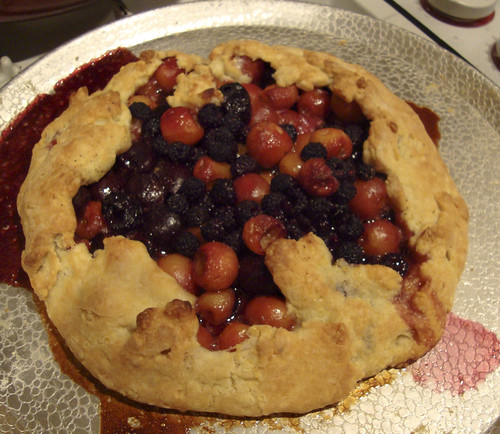
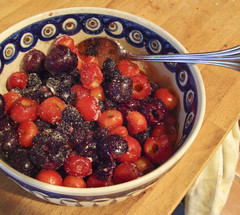
I do a ton of baking for my clients, but recently I feel like I'm been too busy to do any baking for us! Last night I wanted a tart for dessert and I had some gorgeous cherries from Arrowhead Family Farm and some black raspberries from our yard.

The crust in this recipe is a Flo Braker recipe from Baking With Julia. It's a great addition to your baking repertoire and works well in sweet and savory applications. Make sure you give yourself time to let the dough chill - I didn't and pushed it: the results were fine, but the dough was a lot more challenging to work with than it should have been.

Substitute any mixture of fresh fruit that you have on hand. You can layer the fruit daintily into the crust or just tumble it in like I did. If your fruit is super juicy, you can put a tablespoon or two of breadcrumbs or cookie crumbles into the crust before you add the fruit.

Fresh Fruit Galette
Serves 4-6
  • 1 recipe cornmeal galette dough (below)
  • 1 1/2 - 2 cups cut up fresh fruit - I used a mixture of yellow and red cherries and black raspberries
  • 1-3 tablespoons sugar (depending on the sweetness of your fruit)
  • 1 tablespoon butter
On a lightly floured surface, roll the galette dough into a 12" circle (it's okay if it's not a perfect circle, galettes can be "rustic"). Transfer the round of dough to a parchment-lined or non-stick baking sheet.

Stir the fruit and sugar together and spoon the fruit onto the center of the dough, leaving a 3-4" margin of dough. Dot the fruit with the butter.

Lift the dough up and over the fruit, forming a pleated edge (see the picture up there).

Bake for 20-30 minutes until fruit is juicy and the crust is nicely browned.

Cornmeal Galette Dough
From Flo Braker in Baking with Julia
  • 3 tablespoons yogurt or sour cream
  • 1/4 cup ice water
  • 1 cup flour
  • 1/4 cup cornmeal - I like a coarse-grind cornmeal, but you can use a finer grind if you don't want a crunchier crust
  • 1-2 teaspoons sugar
  • 1/2 teaspoon salt
  • 7 tablespoons butter, cut into 1/2" cubes
Whisk together the yogurt and water, set aside in the fridge so it stays cold.

Whisk the flour, cornmeal, sugar and salt together. Toss in the butter and cut the butter in (with your fingers, 2 knives, a pastry cutter or in the food processor - your choice) until you have a mixture that looks like like cornmeal with some pea-sized pieces in it.

With a rubber spatula, fold in the water/yogurt mixture. If the dough seems too dry, add more water, a tablespoon at a time until the dough holds together. Wrap in plastic and chill in the fridge for 2 hours or so at a minimum. The dough freezes really well, so make a double or triple batch and freeze the dough for later.

Friday, July 2, 2010

Use Your Booty: Torta d'Erbe

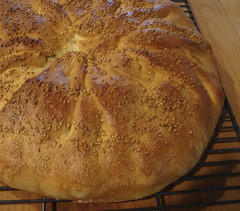
In Italian cuisine, a torta is a pie or tart. This one is a greens pie with a yeasted dough crust. For those of you afraid of pie crust, a yeasted dough might be a nice gateway pastry: you can't overwork the dough like you can with a short crust, the dough provides a firm case for the filling and doesn't get soggy like a pastry crust can.

To make for easy assembly, make the dough when it's convenient for you and after it rises, punch it down and refrigerate until you're ready to assemble the tart. Make your filling ahead as well - a warm filling will make the dough harder to work with. I made my tart in a free-form gallette style with a pleated top but you could easily make your tart in a tart, cake or pie pan if you wish.

Torta d'Erbe
Makes 1 large tart, 6-8 entrée servings
  • 1 recipe yeasted tart dough, below
  • 4-6 cups cooked, chopped greens (I used kale and Swiss chard in this tart)
  • 4 ounces mozzarella, cubed
  • 1 ounce parmesan cheese
  • 1/4 cup chopped pitted Kalamata olives
  • salt and pepper to taste
  • red wine vinegar
  • 2 eggs, beaten
  • 1 egg for egg wash
  • sesame seeds for garnish
Combine the greens, cheeses, and olives. Combine well and taste. Add salt & pepper to taste. If you think the greens need more acidic brightness stir in a few drops of red wine vinegar. When you're happy with the seasoning, stir in the 2 eggs.

On a lightly flour surface, roll the tart dough into a large circle (about 18"), sprinkling with more flour as needed to keep the dough from sticking. Transfer the dough onto a greased baking sheet or into an 11" tart pan.

Evenly spread the filling onto the dough, leaving a 4" margin if you're using a baking sheet and over the entire tart pan if using a tart pan. Lift the dough up and over the filling, pleating the dough to layer it evenly across the top of the tart.

Beat the other egg with a tablespoon of water and brush the egg wash over the tart. Sprinkle the tart with sesame seeds.

Bake at 375 for 30-40 minutes until the crust is well browned. Check the underside of the tart - if it's not browned well, bake the tart for another 10 minutes or so. Serve warm or at room temperature.

Yeasted Tart Dough
Makes enough for one large tart
  • 2 teaspoons active dry yeast
  • 1/2 teaspoon sugar
  • 1 cup room temperature water
  • 1 egg, beaten
  • 1/2 teaspoon salt
  • 13.5 - 18 ounces (3-4 cups) flour
  • 3 ounces butter, at room temperature OR 1/3 cup olive oil (I like the butter version best)
Stir together the yeast, sugar and water. When the yeast is dissolved in to the water, stir in the salt, egg and half the flour. Stir well to form a stiff paste (use a mixer with paddle attachment if you wish). Stir in the butter (the dough will soften back up). Keep adding more flour until the dough is dough-like.

Turn the dough out onto the counter and knead, adding more flour as needed to keep it from sticking. Knead until the dough is tender, shiny and smooth, about 10 minutes of contemplative kneading. It shouldn't be sticky. Transfer dough to an oiled bowl and cover bowl with plastic wrap

Let dough rise for about 1 hour, until doubled. Form tart as above, or if you aren't ready to make the tart, press the dough down to deflate it, recover and put the dough in the fridge until you're ready to make the tart.

You can freeze the dough for a week or so: put the dough into a ziploc bag, press out the air and freeze. Let thaw in a cool place for 6-8 hours.

This Summer, I am chronicling my first CSA (Community Supported Agriculture) experience. My CSA share is from Arrowhead Farm, a farm based in Newburyport, MA. Each week, I am posting about what was in my share and what I'm doing with it. By way of full disclosure, I won my share through a raffle and am not paying for it. However, Arrowhead did not know I was entered in the raffle, and I received no special consideration because of this blog. I paid for my livestock share. A full set of all the photos I've taken of this share is here.

Thursday, July 1, 2010

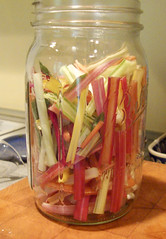
Use Your Booty: Pickled Swiss Chard Stems

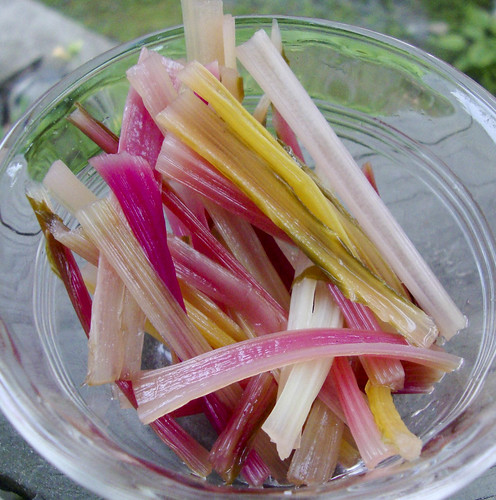
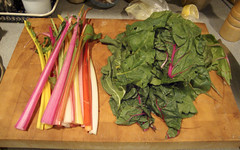
Did you know that Swiss chard is two vegetables in one? You're probably very comfortable using the leafy part of the green, but if you're throwing the stems away, you're losing a major part of this vegetable.

I use the stems in soups or quiches. Treat the stems like celery when cooking them - they benefit from a little extra time in the sauté pan and should be cut the short way into thin slices, to reduce stringiness.

I recently found this recipe for pickled chard stems on the NY Times T magazine blog. I'm not generally a fan of sweet pickles (à la bread and butter pickles), but these are just super. Even better, they're ready to eat in a hour or so.

Pickled Chard Stems
Adapted from a recipe by Peter Meehan and the chefs at Gramercy Tavern
Yields about 1 pint
  • The stems from 1 bunch of Swiss chard
  • 1 thyme sprig
  • 2/3 cup sugar
  • 2/3 cup water
  • 2 cups rice wine vinegar
  • 2 tablespoons kosher salt
  • pinch each of fennel seed, peppercorns, mustard seed
  • couple slices of beet
Cut the chard stems into even lengths, cutting any really thick stems in half lengthwise as well. Put the stems and the thyme sprig into a heat safe jar that just holds the stems (I used a quart canning jar, but should have used a pint jar).

Bring the water, sugar, salt, spices and beet to a boil. Reduce heat and simmer for 5 minutes. Strain the hot brine into the canning jar: it should cover the stems completely. If not, boil up a little more.

Let the pickles cool and then refrigerate.

This Summer, I am chronicling my first CSA (Community Supported Agriculture) experience. My CSA share is from Arrowhead Farm, a farm based in Newburyport, MA. Each week, I am posting about what was in my share and what I'm doing with it. By way of full disclosure, I won my share through a raffle and am not paying for it. However, Arrowhead did not know I was entered in the raffle, and I received no special consideration because of this blog. I paid for my livestock share. A full set of all the photos I've taken of this share is here.

Friday, June 4, 2010

Use Your Booty: Cabbage-Chive Kimchi

I really have grown to love kimchi. For those not familiar with it: kimchi is a Korean fermented pickle of cabbage (usually napa cabbage), flavored with onion, garlic and CHILIES. Think of it as a spicy Korean sauerkraut. Out here in the hinterlands, it's close to impossible to find kimchi in any local market, so you've gotta make your own. Fortunately, kimchi is very easy to make and when I saw Chinese cabbage in my last CSA pickup I knew it was destined to become kimchi.

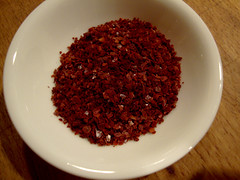
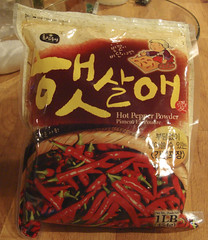
The only special ingredient you need for kimchi is Korean red pepper powder (gochugaru - you'll note that it's not technically a powder, it's more flaky).

You can find it in Korean markets like Hmart or order it online. It's not very expensive and a one-pound bag will last you through many batches of kimchi. If you can't find it Aleppo pepper makes a hotter, more expensive kimchi. Or use paprika for color and cayenne for heat (this is 100% non-traditional of course).

This is a basic recipe, based on the great recipe and How2Heroes video by Alex Lewin. I've modified it down to yield a smaller quantity and I used chives instead of scallions. Try different vegetables and feel free to adjust the heat level (this makes a moderately spicy kimchi) and the amount of garlic and ginger to match your taste.

Basic Kimchi
Yields about 1 pint
  • 1 pound Chinese cabbage
  • 1 cup water
  • 1/4 cup + 2 tablespoons kosher salt
  • 1 tennis ball-sized onion
  • 4 cloves garlic
  • 1" piece of ginger, peeled and roughly chopped
  • 1/4 cup Korean hot pepper powder
  • 2 teaspoons sugar
  • 1 bunch chives, cut into 1" pieces
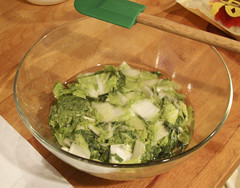
Cut the cabbage into strips and then bite-sized pieces. Dissolve the salt into the water and add the cabbage pieces. Let the cabbage rest in the brine for 4-8 hours (overnight is ok).
When the cabbage has finished brining (it will have lost most of its volume), drain the brine off, rinse the cabbage in cold water and squeeze it dry. Put the cabbage into a bowl while you make the pickling paste.

Puree the onion, garlic and ginger in a food processor, adding enough water to make a paste. Add in the sugar and pepper powder and puree. Scrape the paste out the processor and into the bowl with the cabbage. Add the chives. Stir the paste and the cabbage together until they are well combined. Pack firmly into a glass jar and cover loosely with a lid (the cabbage will start to ferment and you want the gases to be able to escape). Alternatively, use a plastic container and cover the surface of the kimchi with a piece of parchment or waxed paper.

Let the kimchi ferment on the counter for 12-24 hours. When it tastes right to you (I like about 16 hours of room-temperature fermentation), but the kimchi into the fridge. Keep it loosely covered as it will continue to ferment.

As the kimchi ages (over several weeks) it will get funkier and more sour. Use the "fresh" kimchi as a condiment on sandwiches or a side dish with grilled meats. The sourer product is great in soups and stirfries. I love using just a little kimchi, finely chopped, in cole slaws.

This Summer, I am chronicling my first CSA (Community Supported Agriculture) experience. My CSA share is from Arrowhead Farm, a farm based in Newburyport, MA. Each week, I am posting about what was in my share and what I'm doing with it. By way of full disclosure, I won my share through a raffle and am not paying for it. However, Arrowhead did not know I was entered in the raffle, and I received no special consideration because of this blog.

Thursday, May 27, 2010

Use Your Booty: Beet Quiche

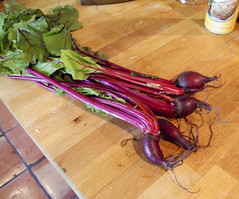
I grabbed a wee little bunch o' beets with my last CSA pickup. There were too few to use as a main dish, or even a side. Somewhere in the mists of memory, I remembered reading a recipe for a beet quiche. So that's what I made.

I cooked the beets until tender, sliced up and sautéed the greens and then combined them and a healthy handful of grated parmesan all into a standard quiche recipe. I made two smaller "quichelets" instead of a large one.

Dinner was a quiche served [cold, because it was crazy-hot here] alongside a ginormous salad (made with CSA lettuce). I included herb leaves and chive blossoms too.

This Summer, I am chronicling my first CSA (Community Supported Agriculture) experience. My CSA share is from Arrowhead Farm, a farm based in Newburyport, MA. Each week, I am posting about what was in my share and what I'm doing with it. By way of full disclosure, I won my share through a raffle and am not paying for it. However, Arrowhead did not know I was entered int he raffle, and I received no special consideration because of this blog.

Wednesday, May 26, 2010

Use Your Booty: Swiss Chard Tabouli Salad

Did you know that Swiss chard is actually two vegetables in one? You use the leaves like spinach and cook them down, or simply slice them and serve them raw. The steams are edible too and since they'll make up a large part of the bunch, it's best to use them. Cut the stems into small pieces and sauté. You can add them to soups, salads or bake them into a quiche.

This salad is a play on tabouli, the Middle Eastern parsley and bulgur wheat salad. I used sautéed Swiss chard leaves and stems as a substitute for the parsley and topped each serving with a few slices of ricotta salata.

Swiss Chard Tabouli Salad
Serves 4 as a main dish or 6 or more as a side dish.
This is great made a day or two ahead.
  • 2 cups bulgur wheat, medium or fine texture
  • 2 bunches Swiss chard
  • 2 tomatoes, diced
  • 1-2 lemons
  • olive oil
  • 6 ounces ricotta salata, farmer cheese, or feta
Cover the bulgur with boiling water and let it steep. Depending on the texture, it will take between 20-40 minutes to soften. Add a little more water if the wheat soaks it all up. When the wheat is tender, drain off any remaining water, squeezing the wheat to make sure it's not soggy.

Trim the chard stems from the leaves. Cut the stems crosswise into 1/2" pieces. Cut the leaves into thin strips. Sauté the stems in a little oil over medium-high heat until just starting to soften. Add the chard leaves and continue to sauté until the leaves are wilted.

Stir the chard and tomato into the wheat. Squeeze lemon juice over the salad and add a good glug or two of olive oil as well as some salt and pepper. Stir and taste. Add more lemon, oil or salt as needed (remembering that you're adding a salty cheese at the end).

If you're serving this a main dish, it's nice to lay slices of cheese across the dish. If it's to be a side dish, crumble the cheese into the salad so it's evenly distributed.

Garnish with a drizzle of olive oil and some edible blossoms if you have them (I used chive and broccoli rabe flowers).

This Summer, I am chronicling my first CSA (Community Supported Agriculture) experience. My CSA share is from Arrowhead Farm, a farm based in Newburyport, MA. Each week, I am posting about what was in my share and what I'm doing with it. By way of full disclosure, I won my share through a raffle and am not paying for it. However, Arrowhead did not know I was entered int he raffle, and I received no special consideration because of this blog.

Monday, May 24, 2010

Tegame alla Vernazzana

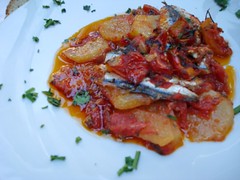
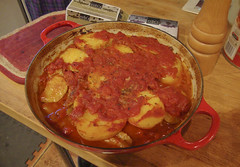
In October of 2008 we traveled to the Italian region of Liguria. One of the best things we ate on that trip (and we ate a lot of great things during those two weeks) was a dish called Tegame alla Vernazzana. We (well, I) ordered it by mistake, and what a happy mistake it was. We were served a gorgeous dish of anchovy fillets stewed with slices of yellow potato and tomatoes. The whole thing was laced with a rich, fruity olive oil and sprinkled with parsley. We scraped the plate clean, using all the bread we could to get every bit of that tomatoey-olive oily-fishy sauce.

After doing a little research it looks like "tegame" is a word for a covered baking dish. Vernazza was the town where we ate it. I guess the English translation of the
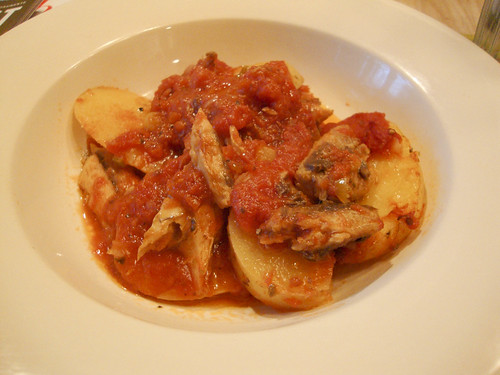
dish's name is "baked dish from Vernazza" - super descriptive. Working from the picture we took of our meal and a little web research, I pulled together this version.

In Vernazza our dish was made with fresh anchovies (see how nice and shiny they are?), but they are hard to find over here. In fact it's hard to find fresh sardines either. I decided to use canned sardines in my version. This also makes it a year-round dish, as opposed to a seasonal one. (An aside: For those who haven't ever tried a fresh anchovy and are thinking of the fillets found in cans, fresh anchovies are a totally different thing. They are oily, but no more than salmon. Their flavor is gently fishy, not strong at all and they are fabulous grilled, fried, sauteed or stewed. If you see them at your local fishmonger, snap 'em up.)

Here's my version of the dish. I hope to get back to Vernazza to try this dish again, but in the meantime, this will have to do.

Tegame alla Vernazzana
Serves 3-4
This dish was very good the next day, gently reheated. I added a splash of water to rehydrate the sauce.
  • 1 pound Yukon Gold potatoes or another buttery, boiling-type potato
  • good quality olive oil
  • 2 cups chopped tomatoes or good-quality canned whole tomatoes, toran into pieces (I used Muir Glen)
  • 2 cans sardines in olive oil
  • 1 cup white wine
  • dried oregano
Preheat the oven to 350.

Slice the potatoes into thick slices: about 1/2" thick. Simmer the potatoes in a pot of salted water until just tender, about 10 minutes.

Drain the potatoes.

In a casserole or baking dish with a lid (mine is an 10" braising pan), start layering the ingredients: glug a healthy dollop of olive oil into the pan. Lay in half the potatoes, half the tomatoes and all of the sardines. Season with salt and pepper and healthy sprinkle of oregano. Lay the rest of the potatoes and then the tomatoes over the top. Sprinkle more oregano over the dish and pour in the white wine.

Cover the dish and put it in the oven until the dish is hot and bubbling, about 30 minutes. Serve in a soup plate, drizzled with more olive oil.

Tuesday, April 13, 2010

Tortilla Española

You're going to read this recipe and your eyebrows are going to rise. You know what and how I cook: you've seen my recipes, so you know I'm no "Sandra Lee Semi-Homemade" kinda gal. But trust me and give this tortilla a try. It's wonderful made ahead and would make a super dinner with a green salad.

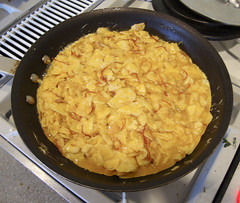
OK, one step back: what's tortilla española? Tortilla is similar to a frittata or an open-faced omelette. It's made with fresh potatoes, sliced thin and fried in olive oil (lots of olive oil). The potatoes are stirred into beaten egg and then cooked into the tortilla.

This version is based on a recipe by Ferran Adrià (yes, that Ferran Adrià). It's been around the interwebs for a while and many have taken a shot at making it (look here for posts by Chez Pim, here for Matt Bites and here for Lobstersquad). Some have hated it (Pim), some loved it (Lobstersquad).

I've brought this tortilla to a few parties. Cut it into small squares and serve it at room temperature. It's a delicious and different contribution to a potluck (plus it's a great small-talk-starter). Most recently, I brought it to a sherry tasting party and I thought it paired well with a variety of sherries (especially manzanilla).

Tortilla Española
Serves 3-4 as an entrée and many more as a cocktail bite.

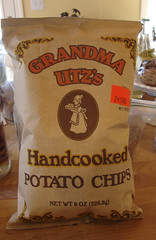
A key factor for success here is the quality of your eggs. My eggs are from my local guy: they've got big, orange yolks and made for a beautiful golden dish. The other big choice you're going to have to make is about the selection of your chip. Ideally, they should be thick-ish and pretty crispy. I think Kettle Chips would be a good choice, but I use Grandma Utz's potato chips which are fried, wait for it, in lard. Yup. And that subtle porkiness really gives the tortilla a rounder flavor and a richer mouthfeel. Check the labels in your supermarket aisle, you might find a lardy local option.

The recipe is easily doubled - use a 10" skillet.
  • 100 grams potato chips (check the bag - they're all labeled with ounces and grams)
  • 4 eggs
  • 1/4 cup caramelized onions, finely chopped or 1/4 cup fried onions (like the kind you can buy at an Asian market)
  • pinch of hot pepper flakes or Aleppo pepper, optional
  • 1/4 tsp salt
  • olive oil
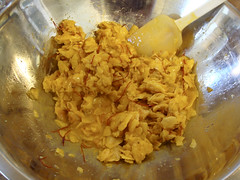
Crush the potato chips up - no too fine, shoot for 1-2" squares. Beat the eggs until well combined and stir in the potato chips. Let the chips sit in the egg for about 5 minutes to soften up.

After the chips have "rested" stir in the onions, pepper flakes (if using) and salt.

Heat a small non-stick skillet (about 6") and drizzle in a little olive oil. When the oil and skillet are hot, pour in the egg mixture (you may feel like there's not enough egg, but there is). Lower the heat to low and cook the eggs slowly. When the tortilla is starting to set up the bottom will be firm, and the center is starting to solidify. This will take about 5 minutes.

Flip the tortilla (Place a plate over the top of the skillet and flip the tortilla onto the plate. Slide the tortilla, uncooked side down back into the skillet.). Cook another 5 minutes or, until cooked to your liking. You can test doneness buy cutting a little bit into the tortilla and seeing how runny it is.

Enjoy warm or at room temperature.

Sunday, March 28, 2010

Foodbuzz 24, 24, 24: A Greek Independence Day Celebration

March 25 is a National Holiday in Greece. It commemorates the start of Greece’s war of independence over the Ottoman Empire. Prior to the start of the revolution, The Ottoman Empire had ruled Greece for nearly 400 years. The revolution lasted from 1821 to 1832, when the treaty of Constantinople was signed.

If you live an area with a Greek population, look for Independence Day parades and celebrations on the 25th or the weekend after it.

This Saturday, with the help of Foodbuzz, I hosted a Greek Independence Day party for friends. Due to the fact that Independence Day falls during the observance of Lent, I decided to [mostly] follow the dietary restrictions that Greeks have to follow when planning my menu. This means that menu shouldn’t contain meat (although certain types of seafood are permitted), dairy or eggs.

Greek Orthodox Lent has very strict dietary restrictions. During Lent, practicing Orthodox Christians must abstain from eating meat, or meat products (so this means no dairy or eggs either) and fish (shrimp, squid, octopus and shellfish are fine). Ultimately, you consume a primarily vegan diet (except for certain types of seafood) for the entire 40 days.

There are fasting exemptions for certain feast days, particularly those celebrating the Virgin Mary (Panagia). On those days, Greeks can also include finfish in their diet. Due to its ease of storage and transport, salt cod (also known as baccala or bacalao) has become traditional on Annunciation Day, March 25th. Annunciation Day is the same date as Independence Day, so we can take advantage of the lifting of certain dietary restrictions.

One of Greece’s greatest culinary traditions is that of mezethes.
Mezethes are small dishes usually eaten with drinks – ouzo of course. They fall into the same place that tapas or antipasti do in Spanish and Italian cuisine. A great advantage for the party host us that a lot of them can be made ahead and plated up when your guests arrive so there’s less hands on work to do when folks come over.

I made a collection of dishes that would show the variety of dishes that can make up a mezethes table. In true Mediterranean fashion, I made too much to eat and everyone did a great job keeping up with the parade of plates coming out of the kitchen. I tried to keep my Independence Day menu in line with the dietary restrictions outlined by Lent and Annunciation Day.
I confess there were few dairy items on the table and I’ve noted that in the menu list below.

The Menu

  • Salt Cod Fritters with Skordalia (garlic-walnut sauce) - recipe below
  • Hearty Greens Pies
  • Olive Pies
  • Beet and Orange Salad
  • Grilled Octopus with Roasted Lemon Sauce - recipe below
  • Ktipiti (tangy cheese dip) – contains dairy
  • Tzatziki (yogurt-cucumber dip) – contains dairy
  • Melitzanosalata (eggplant spread)
  • Taramasalata (cod roe spread)
  • Pickled Artichoke Hearts
  • Fava (yellow split peas) with Tomato-Caper Sauce
  • Stuffed Grape Leaves with pistachios and currants
  • Tahini Cake with Walnuts, Candied Kumquats and Cherries
  • Yogurt Honey Cups – contains dairy
  • Fruit


The Drinks

Ouzos: Barbayianni & Ploumari (both from the island of Lesbos)
Red Wines: Notios (Peleponnese), Argyros (Santorini), Axia (Florina – thanks Dale!)
White Wines: Amethystos (Drama), San..Torini (Santorini – thanks Bill!)
Beers: Opa-Opa and Mythos (thanks again Bill)

Recipes

Salt Cod Fritters

You can find salt cod in a lot of supermarkets. It’s usually in the refrigerator case where pre-packaged seafood is sold. It may be in a bag or a little wood box. Store it in your refrigerator until you’re ready to use it. The hardest part of this recipe is remembering to start soaking your cod a day ahead.

  • 1 1/2 pounds boneless, dry-salted baccala
  • ¼ cup chopped dill
  • 1 cup beer, I used a lager
  • 1-1½ cups all-purpose flour
  • oil, for frying – I like an olive oil / vegetable oil blend
  • salt and pepper

In a large bowl, cover the baccala with cold water. Soak, refrigerated, for 24 hours. Changing the water every 6 to 8 hours.

Drain for the last time and pat dry with paper towels. Shred the baccala with your hands (you’ll have to tear it), for a finer texture in the finished dish, use a knife to cut the baccala into short lengths and then shred the pieces apart. Add the dill to the baccala.

In a separate small bowl, whisk the beer into the flour. Stir into baccala until combined. If it seems too stiff add a little more beer, too loose, add flour. You want a batter than will drop off a spoon, but still hold its shape.

Heat the oil in a deep skillet over medium-high heat. When the oil is hot (about 325-350), gently drop small amounts of batter into the oil (about a generous tablespoon). Don’t crowd the pan, you will need to make these in batches. Cook the fritters until golden brown and drain on paper towels. Sprinkle with salt and pepper and serve with skordalia.

Skordalia (Garlic-Walnut Sauce)

This version of this sauce uses stale bread as a thickener. There are also versions that use cooked potatoes, but I prefer this version. I used pita, since I had it on hand – I needed one and a half pieces to make three ounces.

  • 4 slices (about 3 ounces) stale white bread
  • 1 cup shelled walnuts
  • 6 cloves garlic, peeled
  • 1/2 cup extra-virgin olive oil
  • 1/2 teaspoon kosher salt, plus more to taste
  • juice of 1 lemon
  • 1 tablespoon red white vinegar

Soak the bread in 1/2 cup water for 2 minutes. Press excess water from the bread so that it is damp.

Put bread, walnuts and garlic in a food processor and pulse until a chunky paste forms. Add the olive oil and salt and process until well blended – it may not get completely smooth. Transfer the mixture to a bowl and stir in the lemon juice and vinegar. Adjust salt to taste.

Braised Octopus with Roasted Lemon Sauce

This dish was real star of the party. It was actually the first time I cooked octopus, and so I was more than little worried about it turning out well. I used the braising method from Michael Psilakis’s fabulous Greek cookbook How to Cook a Lamb and a modification of his roasted lemon purée as a sauce.

I found octopus in the freezer case of the supermarket. A Greek family owns one of our local supermarket chains and some of their locations carry frozen octopus (for local reference, Market Basket in Danvers, MA was where I found mine). Call around your local area, it’s probably easier to find than you think.

My octopi (I bought two) were 2.5 and 1.5 pounds respectively and provided 12 small appetizer portions as part of my meze table. The method is infinitely scalable, so I’m going to give you the technique, but feel free to scale it up or down, depending on how many people you’re feeding. Also great, you can do almost all the cooking a day ahead and just heat it right at mealtime.

  • Octopus, thawed if frozen
  • Garlic cloves, peeled
  • Chili flakes
  • Bay leaves

Your octopus will most likely be whole. (I did not cook the head I just used the tentacles.) With a pair of kitchen shears, cut the tentacles from the octopus body. Rinse the tentacles and then dry them with paper towels.

Heat the oven to 375 degrees.

Heat a large skillet over high heat. When the skillet is super hot, lay a few tentacles, sucker-side down into the pan. The tentacles will contract as they hit the pan, don’t be alarmed. Sear the tentacles for about 2 minutes, and then put them into a braising dish (a covered casserole or oven safe dish with the top covered in foil). They will turn red and will curl up a bit. Repeat the process with the remaining tentacles, making sure the pan gets superhot each time and making sure not to crowd the pan. (I seared mine in four batches.)

Add garlic cloves (I used 6 whole cloves), chili flakes (I used about 1 teaspoon) and a bay leaf to the braising dish along with the octopus. Cover the dish and put the pot into the oven. That’s right, do not add any liquid to the pan. Braise, covered for an hour to two hours, depending on the size of your octopus tentacles.

My tentacles were pretty thin, so my octopus was done in one hour. It’s done when you can slide a sharp knife easily into the flesh. If it feels tough at all, return the octopus to the oven to continue braising. (You should be able to cut it with a table knife without any sawing.)

At this point, you can put the octopus into the fridge until it’s time to serve it.

When it’s time to serve, heat a grill pan, or charcoal or gas grill to very hot. Remove the tentacles from their braising liquid (which will likely have formed a rich jelly) and lay them into the pan or onto the grill. Depending on the size of your pan, you should do this in batches. Grill until hot and slightly charred – about 1-2 minutes.

Serve with an oil and lemon salad dressing or the Roasted Lemon Purée.

Roasted Lemon Purée

This is also a method from Michael Psilakis’s fabulous Greek cookbook How to Cook a Lamb. This time I had to use “regular” supermarket lemons, but if you have Meyer lemons on hand do use them in this preparation.

Yields about 2 cups

  • 2 lemons, well scrubbed
  • 2 cloves garlic
  • 2 tablespoons Dijon mustard
  • ½ cup olive oil
  • sugar, to taste
  • salt and pepper to taste

Place a rack (roasting rack or cooling rack) into a baking dish or roasting pan.

Wrap the lemons in foil, place them on the rack and roast in a 325-degree oven for about 90 minutes. The lemons will feel super squishy. Let them cool until you can handle them comfortably

Cut or tear open the lemons and remove the seeds. Remove the lemon pulp and place it into a food processor. Scrape away as much pith as you can from the inside of the lemon and coarsely chop the peel. Add the peel and any juices to the processor. Add the garlic and mustard to the processor and purée until smooth. Continue pureeing as you add olive oil through the feed tube. Taste the puree and add sugar (this amount will vary depending on how much pith you got off your lemon peel). Add salt and pepper to taste.

You can use the puree as is (it packs quite a punch) or thin it out with mayonnaise, more oil or crème fraiche or cream.

For the octopus, I dressed the serving plate with the puree and then drizzled additional oil over its surface. I placed the octopus on top of the puree so people could scoop up a little puree with each tentacle.


More about Foodbuzz and the 24, 24, 24 program: Each month, Foodbuzz sponsors events run by 24 different bloggers. 24 Meals, 24 Hours, 24 Posts is a great way to see what folks are doing all around the world. Check out the Foodbuzz 24, 24, 24 page to see what everyone did this month!

Monday, February 8, 2010

Jim Lahey's No-Knead Breads

Jim Lahey is the owner of Sullivan Street Bakery in New York City. He opened the bakery in 1994 and has been spreading the love of great bread since then. Lahey's no-knead bread recipe achieved amazing popularity in blog circles in November 2006 when Mark Bittman published a story about this method in the New York Times.

Since then, several books have been published (not by Mr. Lahey) about the method. This past fall, Lahey finally published his book of recipes and techniques: My Bread. I'm not going to give you any recipes from the book, because I want you to go buy it. If you want to test-drive the recipes, follow the Bittman link for a basic recipe and method.

My Bread has really revolutionized the way I'm baking bread these days. That basic principle behind this method is that of hands-off gluten formation. Gluten strength can be developed in one of two ways: by kneading the dough, or by letting the dough rest and letting the yeast do all the work. Letting the bread do the work for you makes a lot of sense.

Think about it: in ye olden tymes, back before the days of a Kitchenaid on every counter, people baked bread. Yes, they probably kneaded it by hand, but even with steady kneading the bread wouldn't have gotten worked over the way our modern mixers do it. Also, traditional baking relied on natural leavening which would have required longer rising times.

The no-knead method has one major disadvantage: it's not for the speedy baker. The dough really does need to work on its own. This means a minimum of 8-10 hours of rising time. But this also mean more flavor in the bread.

You don't need a lot of special equipment to make this bread. You do want a scale (but you should own one anyway) otherwise your results won't be consistent. Other than a scale, a big bowl, a rubber spatula and covered dutch oven are all you really need. Feel free to use this an excuse to buy a fancy Le Creuset or Emile Henry Dutch oven if you wish. I've done fine however, with a knockoff Dutch oven from Home Goods or Target, or a Lodge cast iron Dutch oven. You can also use a stainless pot with an oven-safe lid.

Now the breads (I'll be posting more pictures in this Flickr set as time goes by):

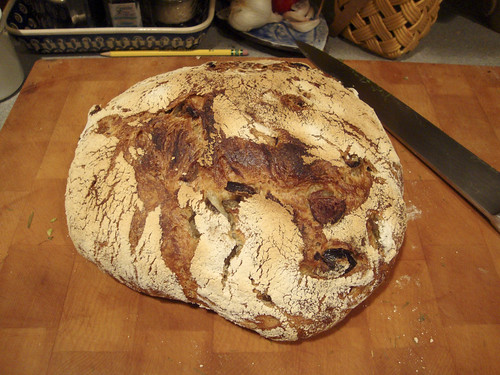
The glamour shot at the top of this post is rosemary-olive bread.

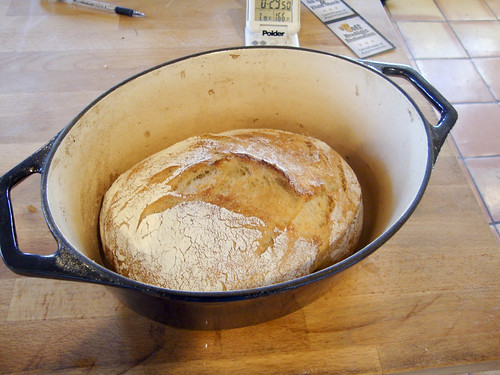
The bread in the pot is a wheat/white combo halfway through baking.

The sandwich loaf was made by gently folding the dough into a loaf shape and then placing it into a well greased loaf pan. This batch was over-proofed when it went into the oven: You can see that in the crappy oven spring (see how that slit in the top didn't really open up?). The flavor was still great and the bread made fabulous toast.

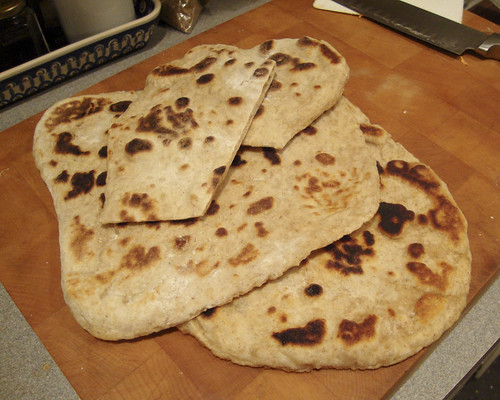
The flatbreads are made from the dough after its first rise. Take the dough, portion it into small balls (about 6 per recipe) and then roll them our into flat, tortilla-like discs. I baked them in a hot cast iron skillet. They bubbled up beautifully as you can see.

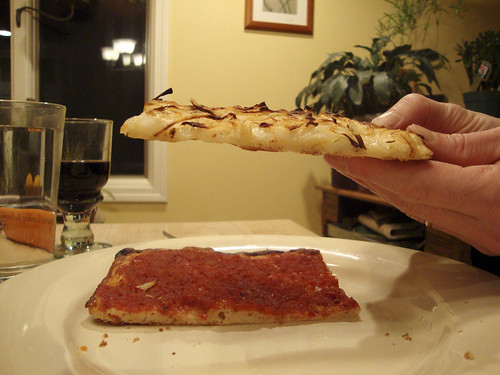
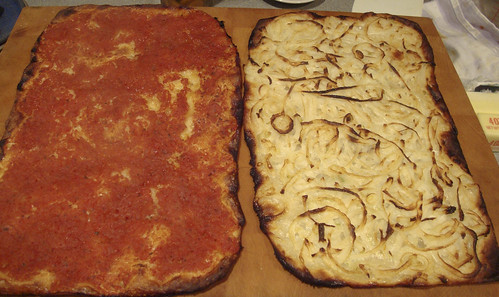
The pizza is made from a different recipe: it's much stiffer than the bread dough. It makes for a deliciously crisp-crusted pizza. You load the dough up with toppings, sliced super-thin and then blast the pizzas in a 500-degree oven. These are pictures of the tomato and onion pizzas.

Other no-knead bread posts from friends in the blogosphere
Smitten Kitchen: No-Knead Bread


Tuesday, January 26, 2010

Detox: Stat!

So Dave and I went to Providence, Rhode Island this weekend. I'm sure Providence has a lot to offer: museums, great architecture, shopping, etc. but we went for the food. I'll be recapping the whole weekend shortly, but let's leave it here for now: we ate a lot. A. LOT.

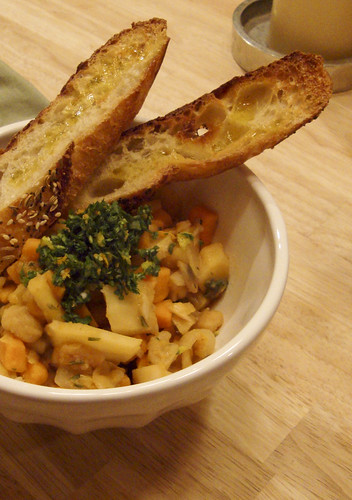
When we got home Sunday, we felt a little, well ... bilious. I decided to go 100% vegetarian for dinner and make a vegetarian stew for us. This was a much better detox than a smoothie or juice-base dinner. We felt satisfied but not overly full. The gremolata made it taste really fresh.

Weekend Detox Winter Vegetable Stew
Modify this based on what vegetables you have on hand. I used chickpeas in this version, but you could use another bean, or lentil, or leave the beans out altogether.
Serves 3-4
  • olive oil
  • 1 onion, chopped
  • 1 sweet potato, peeled and chopped into bite-sized pieces
  • 3-4 baby turnips, chopped into bite-sized pieces
  • 4 parsnips, peeled and chopped into bite-sized pieces
  • 2 carrots, peeled and chopped into bite-sized pieces
  • 2 cups low-sodium chicken broth or water
  • 2 cups cooked chickpeas (1 large can drained and rinsed)
  • juice of 1 lemon (reserve the zest for the gremolata, below)
  • juice of 1 orange (reserve the zest for the gremolata, below)
  • salt and pepper
Saute the onion with some olive oil in a large skillet until softened. Add the sweet potato, turnips, parsnips and carrots. Sprinkle with a pinch of salt. Stir the vegetables in the skillet, over medium-high heat until starting to brown. Add the chicken broth and let the stew simmer until the vegetables are softened (but they should still have a little bite to them). Add a little water if the stew starts to stick. How much time this takes will depend on the size of your vegetables - the smaller the pieces, the shorter the cook time.

Stir in the chickpeas. Stir in the juices and check the seasoning. Add salt and pepper to taste. Serve topped with gremolata.

Blood Orange Gremolata
This was a nice fresh topper for the stew. It would be lovely over some broiled or grilled seafood too. Gremolata is traditionally made only with lemon zest, but the orange zest gave this a really interesting new dimension.

Yields about 3/4 cup of gremolata.
  • 2 cloves garlic, peeled
  • 2 cups parsley leaves
  • zest of 1 lemon
  • zest of 1 blood orange (or an orange if no blood oranges are to be found)
  • olive oil
  • salt
Either by hand, or in a mini food processor, chop together the parsley, garlic and zests until they are finely minced together. Stir in a little olive oil to loosen up the puree and make it more saucy. Season to taste with salt.

Thursday, January 21, 2010

Black Bean Soup with Savory Cream

Boy, do I like bean soups:
  • they're cheap to make
  • they're easy to make (once that pot's bubbling, you can head off to do whatever else you want
  • they're satisfying
  • they freeze exceptionally well, so you can always have a dinner on hand in the freezer
  • they taste better the day after they're made - perfect for a weekend cook day that results in a weeknight dinner
I didn't think I'd posted a black bean soup recipe before, but I did - almost three (!) years ago. This recipe is a little different from that one. To garnish, I'm using a savory whipped cream that I flavored with lime zest and cumin. It was a nice switch from sour cream and I usually have heavy cream on hand. The lovely ladies at food52 posted on this idea a few weeks ago. I recommend a visit to their site to learn about other savory whipped cream ideas.

Weekends are perfect for whipping up a batch of bean soup, so here are a few others to try:
Black Bean Soup
serves 4-6 - the soup doubles (or even quadruples!) really well
  • 1 onion, chopped
  • olive oil
  • 4 cloves of garlic, minced
  • 2 teaspoons freshly ground cumin
  • 1 pound black beans, picked over (sometime there's a stone or two in that bag) and rinsed until water runs clear
  • 1 cup diced tomatoes (optional)
  • juice of 1 lime
  • salt and pepper to taste
  • 1/4-1/2 cup heavy cream
  • zest of 1 lime
  • 1 teaspoon ground cumin
Saute onion over medium-high in a a little oil until softened. Add the garlic, cumin and a healthy sprinkle of salt. Stir and saute a few minutes until fragrant. Add black beans, tomatoes (if using) and cover with water by 1". Bring to a boil and then reduce heat to a simmer. Let soup simmer until beans are very soft. Depending on the age of the beans you're using, this could take anywhere from 1-3 hours. Stir the soup occasionally to make sure it's not sticking to the bottoom of the pot. Also, add water as needed, to keep things "soupy".

When the beans are cooked down the soup is pretty much done. Taste the soup for salt and pepper and adjust the seasoning as needed.

To garnish with the whipped cream: whip the heavy cream, lime zest and cumin with a whisk or electric mixer until it forms soft peaks.

Serve the soup topped with the cream - I sprinkled a little cilantro across our soup, but that's not required of course.

Saturday, January 16, 2010

Borrachos

Delicious. That's all I gotta say. This recipe for borrachos (drunken beans) is from Jen at Last Night's Dinner. Her blog is loaded with gorgeous pictures of the food she prepares for herself and her husband.

Until recently, Jen only posted pictures of her dinners and we had to live without her recipes. But she is one of the contributors to the recipe site Food52 and posted this recipe in the "Best Bean Dish" category. Her recipe and its history can be found here. Check out her other recipes while you're there: her dishes are interesting and delicious.

I made a few small changes to this recipe based on what I had on hand: I used a can of Ro-Tel tomatoes and green chilies instead of diced tomatoes, and I used Greek oregano instead of Mexican. I also used my own home-cured bacon instead of store-bought slab bacon. I'm sure it will be just as good with store-bought bacon, but this was a great way to showcase my homemade stuff!

The beans made a filling and satisfying dinner: I served them as an entree with a quick slaw (finely shredded cabbage with lime, cilantro and salt) and homemade corn tortillas. I drizzled some creme fraiche over the top of the beans and sprinkled some fresh cilantro over the top. As expected, they were even more fabulous the next day.

Friday, January 8, 2010

Ribollita

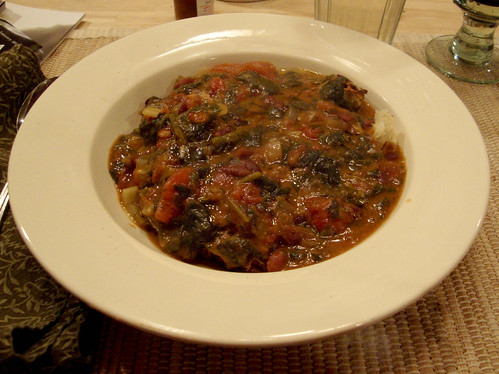
Ribollita is a Tuscan stew, named for the fact that it's "reboiled". What's more important for you and me, is that it's a super delicious soup/stew and a perfect weeknight meal.

The traditional approach to ribollita is to take leftover minestrone soup and stale bread and boil them together to thicken the soup. This can make a really THICK soup - I hav a recipe for leftover ribollita that suggest you cut the leftovers into slices and fry them up. I didn't have any leftover minestrone, but I had stale bread on hand (I have been cooking from Jim Lahey's My Bread like a demon - thus, lots of stale bread. more to come on My Bread shortly.).

The recipe I'm giving you is based on what I did for dinner; I make no claims as to its authenticity as it's a much faster version of what should be a two-day dish. Substitute whatever vegetables and beans you have on hand. If you don't have stale bread, you can use fresh bread and dunk it instead. Whatever bread you use, make sure it's a "rustic" style loaf - it should have a sturdy crumb and can be white or whole wheat.

Weeknight Ribollita
Serves 3-4 hearty appetites
  • 1 onion, chopped
  • 3 stalks celery, chopped
  • 2 carrots, chopped
  • 5 cloves garlic, minced or pressed
  • piece of parmesan rind, optional - this is the hard rind on a hunk of parmesan
  • 1 large can (28 oz.) whole tomatoes
  • 2 small cans (15 oz.) of kidney beans, drained - I used dried beans that I had cooked and stored in the freezer for this, but I figure most of you would use canned beans (as I would if I didn't have cooked beans on hand)
  • large bag of frozen chopped spinach - use cabbage, kale, collards, broccoli rabe, or any other combination of greens. This is what I had on hand.
  • 2-3 thick slices of stale bread, from a rustic loaf, see note above
  • salt and pepper
  • good quality olive oil
In a soup kettle or large pot, saute the onion, celery and carrots in a little olive oil until starting to soften, but not browned, about 8 minutes. Add the garlic and saute another minute or two, until fragrant.

Chop the tomatoes up and add to the pot (the easiest way to do this is crush the tomatoes with your hands as you add them to the pot, second easiest is to cut them up in the can with a pair of scissors). Add the beans and parmesan rind, if using, to the pot. If using cabbage or another tough green, add it to the pot now. If the pot seems too dry add a little water to the pot. Stir, reduce the heat and simmer for about 10 minutes; the carrots should be tender.

Add the chopped spinach to the pot, if using, and simmer another 5 minutes or so. Taste for seasoning and add salt and pepper to taste. Adjust the texture of the soup with water: it should be on the soupy side of stew as it will thicken up once you add the bread. Check again for salt and adjust if necessary.

Tear the slices of bread into crouton-sized pieces and lay into the bottom of soup bowls. Ladle the soup over the bread and then drizzle with olive oil. Don't eat the parmesan rind.

Mangia!

Thursday, December 3, 2009

Braised Fennel: Beet 'n' Squash You

Mel of Bouchon for Two and Leela of She Simmers are proud to present Beet n Squash YOU! -- a monthly food- fight wherein the stupendous virtues of vegetables are extolled.

I'm always a fan of a good food fight, especially one that gets people to eat their vegetables. Battle Fennel is on the calendar for December. I really enjoy fennel: its crisp crunchiness, the gentle hint of anise (I grew up drinking ouzo, so I came on board to licorice love early), its gentle palate-cleansing ability.

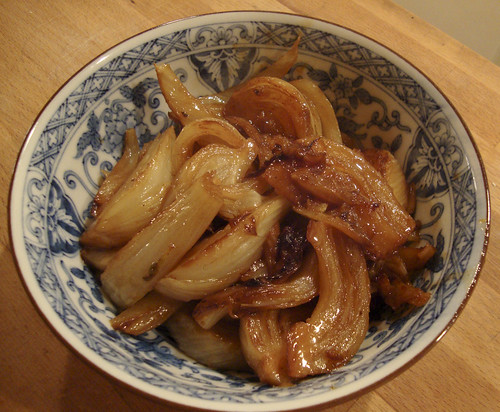
Fennel's other side comes out through braising. The anise flavor is muted by the braising, crispiness is traded for melting tenderness, and a deep rich flavor comes through. Braised fennel can be used as a side dish, baked into the top of a focaccia or as a pizza topping. Make a sublime cream of fennel soup by pureeing the braised fennel with a cooked potato and enough stock to make it soup-ike. Finish with a tot of cream and season with salt and pepper to taste.

Braised Fennel
Yields about 3 cups of braised fennel.
This braising method works with lots of other vegetables too - try carrots, celery, leeks, etc.
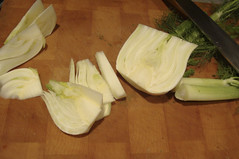
  • 2 large heads of fennel, cut into wedges, tough core cut out
  • 2-3 cups of chicken broth (or vegetable stock if you want this to be vegan/vegetarian)
  • 2 tablespoons of butter or oil
  • salt and pepper to taste
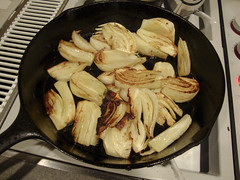
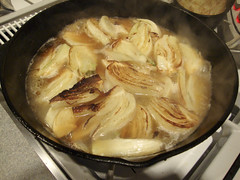
Heat the butter or oil in a large skillet over medium-high heat. Saute the fennel until it is browned well. This will take about ten minutes, depending on how sweet your fennel is.

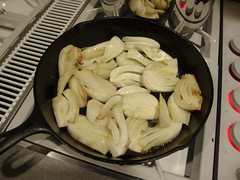
Pour enough stock into the pan to nearly cover the fennel. Bring to a simmer, reduce heat to low, and cover the pan. Simmer gently until the stock is absorbed into the fennel, about 10 minutes.

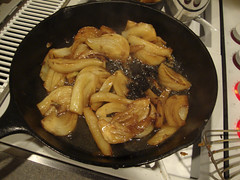
The fennel will be fork tender and the broth will have made a light glaze on the bottom of the pan. If the fennel is tender but there is more liquid than you want, take off the cover, turn up the heat and cook down the broth to a glaze.

Season with salt and pepper. Gild the lily, ahem the fennel, by adding a little butter if you wish.

Enjoy, and fear not the fennel!
Blog Widget by LinkWithin