Showing posts with label teach a man to fish. Show all posts

Monday, May 24, 2010

Tegame alla Vernazzana

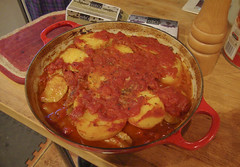
In October of 2008 we traveled to the Italian region of Liguria. One of the best things we ate on that trip (and we ate a lot of great things during those two weeks) was a dish called Tegame alla Vernazzana. We (well, I) ordered it by mistake, and what a happy mistake it was. We were served a gorgeous dish of anchovy fillets stewed with slices of yellow potato and tomatoes. The whole thing was laced with a rich, fruity olive oil and sprinkled with parsley. We scraped the plate clean, using all the bread we could to get every bit of that tomatoey-olive oily-fishy sauce.

After doing a little research it looks like "tegame" is a word for a covered baking dish. Vernazza was the town where we ate it. I guess the English translation of the
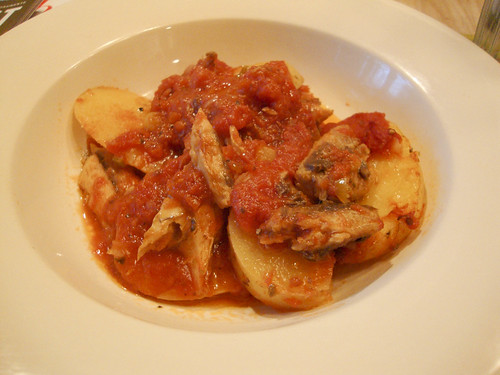
dish's name is "baked dish from Vernazza" - super descriptive. Working from the picture we took of our meal and a little web research, I pulled together this version.
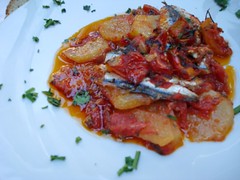
In Vernazza our dish was made with fresh anchovies (see how nice and shiny they are?), but they are hard to find over here. In fact it's hard to find fresh sardines either. I decided to use canned sardines in my version. This also makes it a year-round dish, as opposed to a seasonal one. (An aside: For those who haven't ever tried a fresh anchovy and are thinking of the fillets found in cans, fresh anchovies are a totally different thing. They are oily, but no more than salmon. Their flavor is gently fishy, not strong at all and they are fabulous grilled, fried, sauteed or stewed. If you see them at your local fishmonger, snap 'em up.)

Here's my version of the dish. I hope to get back to Vernazza to try this dish again, but in the meantime, this will have to do.

Tegame alla Vernazzana
Serves 3-4
This dish was very good the next day, gently reheated. I added a splash of water to rehydrate the sauce.
  • 1 pound Yukon Gold potatoes or another buttery, boiling-type potato
  • good quality olive oil
  • 2 cups chopped tomatoes or good-quality canned whole tomatoes, toran into pieces (I used Muir Glen)
  • 2 cans sardines in olive oil
  • 1 cup white wine
  • dried oregano
Preheat the oven to 350.

Slice the potatoes into thick slices: about 1/2" thick. Simmer the potatoes in a pot of salted water until just tender, about 10 minutes.

Drain the potatoes.

In a casserole or baking dish with a lid (mine is an 10" braising pan), start layering the ingredients: glug a healthy dollop of olive oil into the pan. Lay in half the potatoes, half the tomatoes and all of the sardines. Season with salt and pepper and healthy sprinkle of oregano. Lay the rest of the potatoes and then the tomatoes over the top. Sprinkle more oregano over the dish and pour in the white wine.

Cover the dish and put it in the oven until the dish is hot and bubbling, about 30 minutes. Serve in a soup plate, drizzled with more olive oil.

Grill-Roasted Mussels with Green Garlic and Sorrel

My Sundays are spent at the Newburyport Farmers' Market, selling my bakery items. While it's great to be outside and meeting people, one real drawback to selling at the market is that I don't get to shop at all. So imagine my pleasure at the end of last day's market when a boy ran up to me and handed me a bag of wild mussels (what a gift!). They were from Eastman's Fish Market, a fisherman-owned and operated seafood market in Seabrook, NH. Eastman's offer a CSF (Community Supported Fishery) program. They are a fantastic addition to our market.


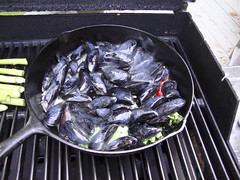
Anyhoo, back to the mussels. It was such a beautiful day yesterday that I wanted to stay outside; so I decided to grill-roast the mussels. Grill-roasting is a great option for seafood in that the seafood can pick up the smokiness from the grill, but you're never in any danger of losing your meal through the grill grates.

My garden is loaded with sorrel and green garlic (immature garlic plants) so I decided I would use them as my primary flavorings. With a loaf of [my] olive bread from the market and a green salad it made a great dinner.

Grill-Roasted Mussels with Green Garlic and Sorrel
Two generous servings
  • 2 lbs mussels, prepared for cooking: rinsed well, any beards removed, dead mussels discarded
  • 3 tablespoons butter
  • 1/2 cup chopped green garlic (or 1 bunch scallions, chopped and 2 cloves minced garlic)
  • 1 dried chile pod (optional)
  • 1 cup sorrel, cut into thin strips (or minced herbs like parsley, dill, chives, and/or fennel)
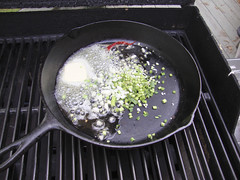
Place a large cast iron skillet (12" or more) on a hot grill (I use a gas grill set on high). Let the skillet get super hot - leave it on the grill for 5-10 minutes.

Add the butter, green garlic and chile pod to the pan. The butter should sizzle up and start to melt very fast. Add the mussels to the skillet. Cover the grill. Let the mussels cook, giving them a stir every few minutes or so. My mussels were cooked through in a little less than 10 minutes. Yours may take more or less time depending on their size, their temperature when you started cooking, etc. Toss the sorrel over the cooked mussels and give it all a stir.

Serve the mussels in deep bowls with bread for dipping. These won't be super-soupy mussels because a lot of the liquid will simmer off on the grill, but the liquid that's left will be concentrated and very flavorful. You might want to add a sprinkle of salt if your mussels aren't briny enough.

Tuesday, December 15, 2009

Fish Chowder

We've lost sight of what a good fish chowder** is. Too frequently chowder is a restaurant dish: a gloppy, salty bowl of soup, lacking seafood flavor. It's usually clam chowder and it most likely comes from a can or a box in the freezer. Ironically, most of us can get reliably good seafood and a great chowder is well within our reach.


Go make this chowder. It's perfect for a cold night and we've got quite a few of those coming up. This recipe is liberally lifted from a recipe by Jasper White. For those of you who don't know Jasper White, or know of him only through his Summer Shack restaurants, I'll point out that he was a major force in Boston's restaurant scene in the '80s and '90s. When Dave and I first moved to Boston, a table at Jasper's was an experience to celebrate. We ate there a few times (in fact, we were even going to get engaged during dinner there, except I got a stomach bug and the proposal we held over until the follow day. I said yes by the way. :-) ).

Fish Chowder
Serves 4

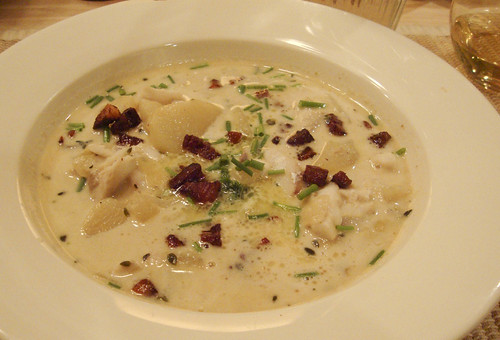
Fish chowder seems like a rather boring name for this dish because it is fantastic. All through dinner we just kept marveling over the flavor. Use the freshest fish you can find. I used a side of pollock from our latest community supported fishery delivery and it was fabulous. I also had some fish broth (fumet) in the freezer from this summer's CSF share, but feel free to use a light chicken broth, clam broth or just plain water.

This recipe is easily doubled or tripled to feed a large group.

This looks like a long recipe, but it takes about 30 minutes, start to finish, and about 15 of that is unattended time while the potatoes are cooking.

  • 2-4 ounces salt pork or bacon
  • 1 medium onion, chopped (about 1 cup of chopped onion)
  • 2 teaspoons fresh thyme leaves, or 1/2 tsp dried thyme
  • 1 pound russet potatoes, peeled and cut into 1/3" thick slices (cut the potato slices in half or quarters if they're bigger than soup spoon size)
  • 2-3 cups fish broth, chicken broth, clam broth and/or water
  • 1 pound skinless fish fillets (try cod, pollock, haddock, hake, etc. any mild white fish will do)
  • 1/2-1 cup heavy cream
  • salt and pepper to taste
  • chopped chives, parsley, fennel and/or dill
Chop the salt pork or bacon into 1/4" dice. Put the pork into a large saucepan or soup pot and cook over medium-low heat until the cubes are starting to crisp and about 2-3 tablespoons of fat have rendered out (this will vary depending on what kind of pork you're using). Raise the heat and cook the pork cubes until they're crispy. Remove the crisped pork from the saucepan and pour off some fat if a lot has rendered out. Reserve the pork for serving time.

Add the onion to the pot and saute in the pork fat, adding a little butter or olive oil if the pan is too dry. Cook until the onion is soft and just starting to brown. Add the thyme and the potatoes. Add enough stock or water to just cover the potatoes (I needed only 2 cups). Bring to a boil and them reduce the heat to keep everything simmering. Cook until the potatoes are soft enough to crush against the side of the pot, about 10-15 minutes. Check the seasoning and add salt and pepper to taste.

Add the fillets to the pot and stir them gently into the soup. Keep cooking on low heat until the fish is cooked through enough to break into large flakes when you stir (the fish isn't cut into chunks before it goes in the pot - the cooking process will allow the fillet to break into bite-sized pieces). When the fish is cooked through, add the cream - adjust the amount to your taste: I used about 1/2 cup of cream in ours and it was rich enough for a weeknight dinner. Recheck the seasoning and adjust with salt and pepper to taste (I like a fair amount of pepper in this).

Ladle into bowls and garnish with the crispy pork and chopped herbs.


** An aside: I can't think or write the word "chowder" without thinking of The Simpsons episode where Freddie Quimby tries to get the family's French servant to say "chowder" properly. Dunno what I'm talking about? Here you go:


Sunday, November 8, 2009

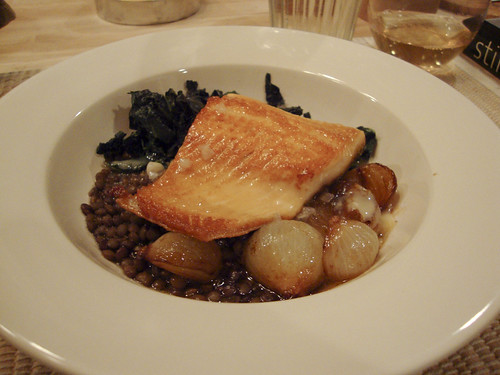
Arctic Char with Lentils and Mustard Beurre Blanc

This is another recipe (with a lousy picture, sorry) I have been meaning to post for you for a while. Arctic char is not a fish you may think of right off the bat, but it's a great fish to seek out and cook with. Char is similar to trout or salmon (they share a family tree) and can be safely substituted in most recipes calling for either. The char you will find for sale is likely farmed and will be a product of the United States, Canada, Iceland or Norway. Check out the Monterey Bay Aquarium's Seafood Watch site for more info on choosing sustainable seafood options.

This recipe is part of Teach a Man to Fish, an online event focused on drawing attention to the problem of overfishing and to cooking with sustainable seafood. In its third year, Teach a Man to Fish is organized by the lovely Jacqueline Church. Visit her site here for more information and lots of recipes and seafood info.)

This dish has lots of components: the fish, the sauce, lentils, kale and onions. Everything but the fish and the sauce can be made ahead (even a few days ahead), and you can just use a few components instead. For instance, the char and sauce would be nice over pasta or rice. I'm going to to give the components as separate recipes so you can decide what to use.

All recipes serve four people. I plated my dish with lentils in the bottom, kale and onions on the sides. Then I placed the char on top with a healthy dollop of beurre blanc to melt over the plate.

  • 1 1/2 pounds Arctic char fillets, cut into four pieces of about 6 oz. each
  • salt and pepper
  • oil for pan
Heat a 12" skillet, preferably not non-stick, over high heat. While the pan is heating, prepare the fish fillets: lay them skin-side down on a sheet of paper towels to ensure the fillets are really dry. Sprinkle the flesh with salt and pepper. Pour a little oil in the very hot skillet and lay the fillets skin-side down in the skillet. Sear the fillets about 3 minutes, until the skin is browned and crisp. Carefully turn the fillets and cook another 3-4 minutes until the fillets are cooked through.

Mustard Beurre Blanc
  • 1/2 cup white wine
  • 1 shallot, minced fine
  • 1 tablespoon dijon mustard
  • 8 ounces (yes, that's two sticks) unsalted butter, cut into small pieces
  • salt to taste
Put the wine and shallot in a small saucepan and boil over medium-high heat and reduce to 2 tablespoons. Whisk in the mustard.

Whisk in butter, piece by piece. Don't add all the butter at once, you need to emulsify the sauce with the butter, and you won't succeed if you try to rush it. Whisk vigorously, adding each piece as it's absorbed into the sauce. When all the butter has been added, season sauce with salt to taste.

Keep sauce warm until time to serve.

Lentilles du Puy
  • 1 cup lentilles du Puy (see my lentil posts here and here for more info on this type of lentil)
  • 1 small onion, diced
  • 2 cloves garlic, sliced thin
  • sprig thyme
  • olive oil
In a medium saucepan (3 quart-ish) over medium heat, saute the onion and garlic until softened and just starting to brown. Add the lentils and stir to coat with oil. Add 2-3 cups water and the thyem and bring to a simmer. Simmer until lentils are cooked through. Depending on the age of your lentils, they will take from 20-45 minutes. Add more water as needed; you want the lentils to stay covered with water while they cook.

When the lentils are tender, remove them from heat. Season with salt and pepper.

The lentils can be made several days ahead and reheated when you need them.

Braised Kale
  • 1 bunch kale, leaves pulled from stems, leaves cut into thin strips
  • 2 cloves garlic, sliced thin
  • oil for sauteing
  • sherry vinegar
Saute the garlic until it starts to soften, add the shredded kale and a sprinkle of salt. Saute over medium heat until the kale is wilted and soft. If the kale starts to stick, or the pan seems too dry, add a splash of water. Season to taste with salt and a splash of sherry vinegar.

Caramelized Onions
  • 10-30 small onions (cippolini or boiling onions - judge how many you need by their size: they're garnish, not a side dish), peeled and halved through the stem end if large.
  • 1 -2 cups chicken broth
  • 1/4 cup sherry vinegar
  • brown sugar
  • olive oil
  • salt and pepper
Saute the onions in a skillet large enough to hold them in one layer. Let them brown gently over medium heat, about 10 minutes. Pour enough chicken broth onto the onions to cover them halfway. Partially cover the pan. Simmer until onions are soft all the way through. Remove cover from pan, turn heat up and boil until the broth is reduced to a glaze.

Deglaze the pan with vinegar and add a sprinkle of brown sugar to make a glaze that coats the onions. Taste: if things are too vinegary add a little more sugar. Add salt and pepper to taste.

Saturday, November 7, 2009

Fried Smelt Po'Boy

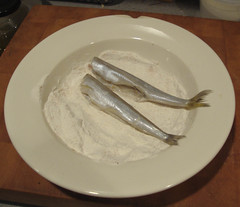
This meal came together as the result of a plan-free shopping trip to Whole Foods. I wandered past the seafood display and saw a tray of fresh smelt (smelts?) on display. I've been trying to cook more sustainable seafood and these seemed like a great option to work with. For some reason, the idea of a smelt po'boy came to me. Inspiration-struck, I hustled through the store and picked up the remainder of what I thought I'd need to make supper: a baguette, a few tangerines (trust me) and a lemon.

The plate would have looked more than a little tan, so I included a salad in my meal's design to keep scurvy at bay.

Fried Smelt Po'Boy with Fennel-Chicory-Tangerine Salad
Disclaimer: I have never eaten a real po'boy, so I make no claims to the authenticity of my sandwich. All I can say is that it was delicious.

This looks like a lot of components, but don't worry: this all came together really fast. Also, there's nothing wrong with using regular tartar sauce, plain butter, skipping the salad, etc.

Makes enough for two servings:

For fish
  • 12 ounces gutted, cleaned smelts (don't worry about the bones - they'll soften up during the frying and will be 100% edible)
  • Wondra flour, for dredging
  • Oil for frying
For fennel-lemon tartar sauce
  • 3 tablespoons mayonnaise
  • Zest of 1 lemon
  • Chopped fennel fronds
  • Hot pepper flakes, to taste
For mustard butter
  • 2 tablespoons butter
  • 2 tablespoons creole mustard
To finish sandwich
  • 12" baguette, cut into 2 pieces and sliced lengthwise (like a book)
For salad
  • Fennel bulb
  • 1 tangerine or clementine
  • 2 handfuls shredded chicory
  • sherry vinegar
  • olive oil
  • salt & pepper
Make tartar sauce: Mix all ingredients together and adjust salt, heat and acid to your taste.

Make mustard butter: Blend butter and mustard together.

Make salad: Thinly slice fennel bulb (a mandoline is great for this). Peel and section the tangerine into segments. Toss fennel and tangerine segments with chicory. Sprinkle a few tablespoons of sherry vinegar over the salad and then a few tablespoons of olive oil. Toss to combine, adding salt and pepper to taste.

Fry the fish: Heat 1/2" oil in frying pan. Dredge the smelts in Wondra flour. When oil is hot (sprinkle a little flour into oil - it should sizzle up and brown quickly), fry the fish in batches until lightly browned. Remove fish from pan and drain on paper towels. Let the oil come up to heat again before frying more fish. (I fried mine in two batches.)

Assemble sandwich: heat the baguettes in a 300 oven until warm and crusty. Spread the inside of the bread with mustard butter. Fill each sandwich with fish (leave some tails poking out the ends, for fun). Sprinkle fish with salt and a squeeze of lemon juice. Top with tartar sauce. Serve with salad alongside or stuffed into the sandwich as you prefer. (We kept our salad on the side and stuffed a little in every now and then.)

(Edited to add: This recipe is part of Teach a Man to Fish, an online event focused on drawing attention to the problem of overfishing and to cooking with sustainable seafood. In its third year, Teach a Man to Fish is organized by the lovely Jacqueline Church. Visit her site here for more information and lots of recipes and seafood info.)
Blog Widget by LinkWithin