Showing posts with label seafood. Show all posts

Monday, July 5, 2010

Make This Please: Scallop Roll

The lobster roll is a staple of the summer dining menu: chunks of lobster meat cloaked in mayonnaise, and accompanied by chopped celery and herbs. When Dave asked for a scallop roll for dinner he was thinking of what we see at the clam shacks around here: deep fried, breaded scallops in a hot dog bun. Somehow I had a brain fade and thought lobster roll instead. Happy accident.

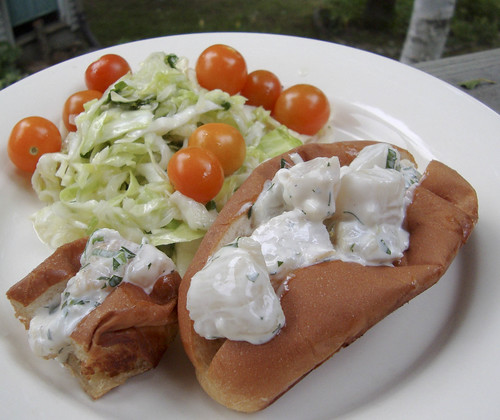
I dressed chunks of cooked scallops with mayonnaise, whisper-thin slices of onion, chopped parsley and scallions and a squeeze of lemon juice. The scallops then got spooned into a butter-grilled hot dog bun.

I cut the richness of the scallop roll by serving it with a lemony slaw and some sun gold tomatoes.

Friday, June 11, 2010

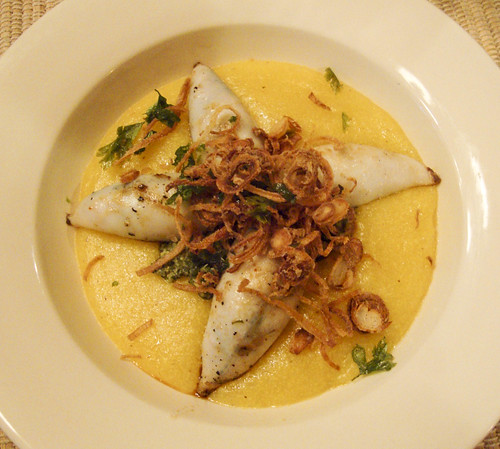
Use Your Booty: Star [Shell]Fish

After a week of CSA cooking I had only a bunch of mustard greens left in the fridge. The original plan was to toss them in a pasta sauce. Then, on a whim, I went to Eastman Fish Market up in Seabrook, NH. Eastman's is run by the Carolyn and Ed Eastman. Ed's a fisherman and he is out on the boats while Carolyn runs the shop and CSF. I forgot my camera so I don't have a pictures for you of their cute seafood market ... soon, I promise.

In addition to all the gorgeous fish in the case, Carolyn was also stocking fresh squid from off Cape Cod. So I picked up some to make for dinner. I have to confess that I wasn't 100% thrilled with the stuffing I made for them, but I like the idea so I wanted to share it with you anyway.

I stuffed the tubes with a mixture of the squid tentacles, chickpeas, mustard greens and lemon zest. Next time I'll try adding some chopped olives or capers - the dish needed a little more zip.

What you've really got to try is the polenta business that's underneath the squid tubes. Take soft polenta, top it with kale pesto and some crispy onions (made with my CSA onions). The contrast between the creamy polenta, the kale and the crispy onions was addicting (in fact I had the leftovers for breakfast this morning).

For crispy onions, slice your onions (or shallots perhaps) super thin. Toss with Wondra flour and then fry in 3/4" of hot oil until brown and, well, crispy. I tossed in a few parsley leaves right at the end (there will be a lot of sputtering). Drain and toss with a sprinkle of salt.

Monday, May 24, 2010

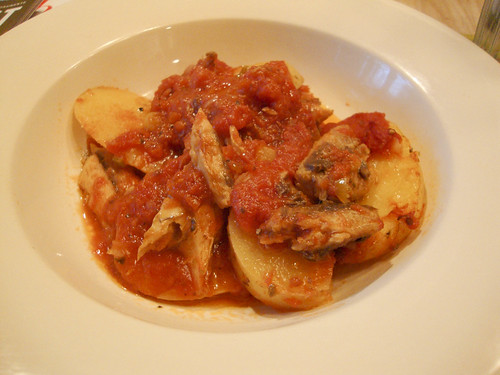
Tegame alla Vernazzana

In October of 2008 we traveled to the Italian region of Liguria. One of the best things we ate on that trip (and we ate a lot of great things during those two weeks) was a dish called Tegame alla Vernazzana. We (well, I) ordered it by mistake, and what a happy mistake it was. We were served a gorgeous dish of anchovy fillets stewed with slices of yellow potato and tomatoes. The whole thing was laced with a rich, fruity olive oil and sprinkled with parsley. We scraped the plate clean, using all the bread we could to get every bit of that tomatoey-olive oily-fishy sauce.

After doing a little research it looks like "tegame" is a word for a covered baking dish. Vernazza was the town where we ate it. I guess the English translation of the
dish's name is "baked dish from Vernazza" - super descriptive. Working from the picture we took of our meal and a little web research, I pulled together this version.

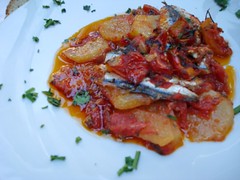
In Vernazza our dish was made with fresh anchovies (see how nice and shiny they are?), but they are hard to find over here. In fact it's hard to find fresh sardines either. I decided to use canned sardines in my version. This also makes it a year-round dish, as opposed to a seasonal one. (An aside: For those who haven't ever tried a fresh anchovy and are thinking of the fillets found in cans, fresh anchovies are a totally different thing. They are oily, but no more than salmon. Their flavor is gently fishy, not strong at all and they are fabulous grilled, fried, sauteed or stewed. If you see them at your local fishmonger, snap 'em up.)

Here's my version of the dish. I hope to get back to Vernazza to try this dish again, but in the meantime, this will have to do.

Tegame alla Vernazzana
Serves 3-4
This dish was very good the next day, gently reheated. I added a splash of water to rehydrate the sauce.
  • 1 pound Yukon Gold potatoes or another buttery, boiling-type potato
  • good quality olive oil
  • 2 cups chopped tomatoes or good-quality canned whole tomatoes, toran into pieces (I used Muir Glen)
  • 2 cans sardines in olive oil
  • 1 cup white wine
  • dried oregano
Preheat the oven to 350.

Slice the potatoes into thick slices: about 1/2" thick. Simmer the potatoes in a pot of salted water until just tender, about 10 minutes.

Drain the potatoes.

In a casserole or baking dish with a lid (mine is an 10" braising pan), start layering the ingredients: glug a healthy dollop of olive oil into the pan. Lay in half the potatoes, half the tomatoes and all of the sardines. Season with salt and pepper and healthy sprinkle of oregano. Lay the rest of the potatoes and then the tomatoes over the top. Sprinkle more oregano over the dish and pour in the white wine.

Cover the dish and put it in the oven until the dish is hot and bubbling, about 30 minutes. Serve in a soup plate, drizzled with more olive oil.

Grill-Roasted Mussels with Green Garlic and Sorrel

My Sundays are spent at the Newburyport Farmers' Market, selling my bakery items. While it's great to be outside and meeting people, one real drawback to selling at the market is that I don't get to shop at all. So imagine my pleasure at the end of last day's market when a boy ran up to me and handed me a bag of wild mussels (what a gift!). They were from Eastman's Fish Market, a fisherman-owned and operated seafood market in Seabrook, NH. Eastman's offer a CSF (Community Supported Fishery) program. They are a fantastic addition to our market.


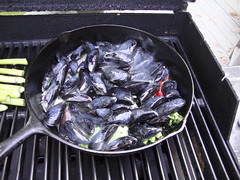
Anyhoo, back to the mussels. It was such a beautiful day yesterday that I wanted to stay outside; so I decided to grill-roast the mussels. Grill-roasting is a great option for seafood in that the seafood can pick up the smokiness from the grill, but you're never in any danger of losing your meal through the grill grates.

My garden is loaded with sorrel and green garlic (immature garlic plants) so I decided I would use them as my primary flavorings. With a loaf of [my] olive bread from the market and a green salad it made a great dinner.

Grill-Roasted Mussels with Green Garlic and Sorrel
Two generous servings
  • 2 lbs mussels, prepared for cooking: rinsed well, any beards removed, dead mussels discarded
  • 3 tablespoons butter
  • 1/2 cup chopped green garlic (or 1 bunch scallions, chopped and 2 cloves minced garlic)
  • 1 dried chile pod (optional)
  • 1 cup sorrel, cut into thin strips (or minced herbs like parsley, dill, chives, and/or fennel)
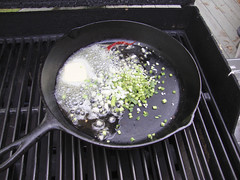
Place a large cast iron skillet (12" or more) on a hot grill (I use a gas grill set on high). Let the skillet get super hot - leave it on the grill for 5-10 minutes.

Add the butter, green garlic and chile pod to the pan. The butter should sizzle up and start to melt very fast. Add the mussels to the skillet. Cover the grill. Let the mussels cook, giving them a stir every few minutes or so. My mussels were cooked through in a little less than 10 minutes. Yours may take more or less time depending on their size, their temperature when you started cooking, etc. Toss the sorrel over the cooked mussels and give it all a stir.

Serve the mussels in deep bowls with bread for dipping. These won't be super-soupy mussels because a lot of the liquid will simmer off on the grill, but the liquid that's left will be concentrated and very flavorful. You might want to add a sprinkle of salt if your mussels aren't briny enough.

Sunday, March 28, 2010

Foodbuzz 24, 24, 24: A Greek Independence Day Celebration

March 25 is a National Holiday in Greece. It commemorates the start of Greece’s war of independence over the Ottoman Empire. Prior to the start of the revolution, The Ottoman Empire had ruled Greece for nearly 400 years. The revolution lasted from 1821 to 1832, when the treaty of Constantinople was signed.

If you live an area with a Greek population, look for Independence Day parades and celebrations on the 25th or the weekend after it.

This Saturday, with the help of Foodbuzz, I hosted a Greek Independence Day party for friends. Due to the fact that Independence Day falls during the observance of Lent, I decided to [mostly] follow the dietary restrictions that Greeks have to follow when planning my menu. This means that menu shouldn’t contain meat (although certain types of seafood are permitted), dairy or eggs.

Greek Orthodox Lent has very strict dietary restrictions. During Lent, practicing Orthodox Christians must abstain from eating meat, or meat products (so this means no dairy or eggs either) and fish (shrimp, squid, octopus and shellfish are fine). Ultimately, you consume a primarily vegan diet (except for certain types of seafood) for the entire 40 days.

There are fasting exemptions for certain feast days, particularly those celebrating the Virgin Mary (Panagia). On those days, Greeks can also include finfish in their diet. Due to its ease of storage and transport, salt cod (also known as baccala or bacalao) has become traditional on Annunciation Day, March 25th. Annunciation Day is the same date as Independence Day, so we can take advantage of the lifting of certain dietary restrictions.

One of Greece’s greatest culinary traditions is that of mezethes.
Mezethes are small dishes usually eaten with drinks – ouzo of course. They fall into the same place that tapas or antipasti do in Spanish and Italian cuisine. A great advantage for the party host us that a lot of them can be made ahead and plated up when your guests arrive so there’s less hands on work to do when folks come over.

I made a collection of dishes that would show the variety of dishes that can make up a mezethes table. In true Mediterranean fashion, I made too much to eat and everyone did a great job keeping up with the parade of plates coming out of the kitchen. I tried to keep my Independence Day menu in line with the dietary restrictions outlined by Lent and Annunciation Day.
I confess there were few dairy items on the table and I’ve noted that in the menu list below.

The Menu

  • Salt Cod Fritters with Skordalia (garlic-walnut sauce) - recipe below
  • Hearty Greens Pies
  • Olive Pies
  • Beet and Orange Salad
  • Grilled Octopus with Roasted Lemon Sauce - recipe below
  • Ktipiti (tangy cheese dip) – contains dairy
  • Tzatziki (yogurt-cucumber dip) – contains dairy
  • Melitzanosalata (eggplant spread)
  • Taramasalata (cod roe spread)
  • Pickled Artichoke Hearts
  • Fava (yellow split peas) with Tomato-Caper Sauce
  • Stuffed Grape Leaves with pistachios and currants
  • Tahini Cake with Walnuts, Candied Kumquats and Cherries
  • Yogurt Honey Cups – contains dairy
  • Fruit


The Drinks

Ouzos: Barbayianni & Ploumari (both from the island of Lesbos)
Red Wines: Notios (Peleponnese), Argyros (Santorini), Axia (Florina – thanks Dale!)
White Wines: Amethystos (Drama), San..Torini (Santorini – thanks Bill!)
Beers: Opa-Opa and Mythos (thanks again Bill)

Recipes

Salt Cod Fritters

You can find salt cod in a lot of supermarkets. It’s usually in the refrigerator case where pre-packaged seafood is sold. It may be in a bag or a little wood box. Store it in your refrigerator until you’re ready to use it. The hardest part of this recipe is remembering to start soaking your cod a day ahead.

  • 1 1/2 pounds boneless, dry-salted baccala
  • ¼ cup chopped dill
  • 1 cup beer, I used a lager
  • 1-1½ cups all-purpose flour
  • oil, for frying – I like an olive oil / vegetable oil blend
  • salt and pepper

In a large bowl, cover the baccala with cold water. Soak, refrigerated, for 24 hours. Changing the water every 6 to 8 hours.

Drain for the last time and pat dry with paper towels. Shred the baccala with your hands (you’ll have to tear it), for a finer texture in the finished dish, use a knife to cut the baccala into short lengths and then shred the pieces apart. Add the dill to the baccala.

In a separate small bowl, whisk the beer into the flour. Stir into baccala until combined. If it seems too stiff add a little more beer, too loose, add flour. You want a batter than will drop off a spoon, but still hold its shape.

Heat the oil in a deep skillet over medium-high heat. When the oil is hot (about 325-350), gently drop small amounts of batter into the oil (about a generous tablespoon). Don’t crowd the pan, you will need to make these in batches. Cook the fritters until golden brown and drain on paper towels. Sprinkle with salt and pepper and serve with skordalia.

Skordalia (Garlic-Walnut Sauce)

This version of this sauce uses stale bread as a thickener. There are also versions that use cooked potatoes, but I prefer this version. I used pita, since I had it on hand – I needed one and a half pieces to make three ounces.

  • 4 slices (about 3 ounces) stale white bread
  • 1 cup shelled walnuts
  • 6 cloves garlic, peeled
  • 1/2 cup extra-virgin olive oil
  • 1/2 teaspoon kosher salt, plus more to taste
  • juice of 1 lemon
  • 1 tablespoon red white vinegar

Soak the bread in 1/2 cup water for 2 minutes. Press excess water from the bread so that it is damp.

Put bread, walnuts and garlic in a food processor and pulse until a chunky paste forms. Add the olive oil and salt and process until well blended – it may not get completely smooth. Transfer the mixture to a bowl and stir in the lemon juice and vinegar. Adjust salt to taste.

Braised Octopus with Roasted Lemon Sauce

This dish was real star of the party. It was actually the first time I cooked octopus, and so I was more than little worried about it turning out well. I used the braising method from Michael Psilakis’s fabulous Greek cookbook How to Cook a Lamb and a modification of his roasted lemon purée as a sauce.

I found octopus in the freezer case of the supermarket. A Greek family owns one of our local supermarket chains and some of their locations carry frozen octopus (for local reference, Market Basket in Danvers, MA was where I found mine). Call around your local area, it’s probably easier to find than you think.

My octopi (I bought two) were 2.5 and 1.5 pounds respectively and provided 12 small appetizer portions as part of my meze table. The method is infinitely scalable, so I’m going to give you the technique, but feel free to scale it up or down, depending on how many people you’re feeding. Also great, you can do almost all the cooking a day ahead and just heat it right at mealtime.

  • Octopus, thawed if frozen
  • Garlic cloves, peeled
  • Chili flakes
  • Bay leaves

Your octopus will most likely be whole. (I did not cook the head I just used the tentacles.) With a pair of kitchen shears, cut the tentacles from the octopus body. Rinse the tentacles and then dry them with paper towels.

Heat the oven to 375 degrees.

Heat a large skillet over high heat. When the skillet is super hot, lay a few tentacles, sucker-side down into the pan. The tentacles will contract as they hit the pan, don’t be alarmed. Sear the tentacles for about 2 minutes, and then put them into a braising dish (a covered casserole or oven safe dish with the top covered in foil). They will turn red and will curl up a bit. Repeat the process with the remaining tentacles, making sure the pan gets superhot each time and making sure not to crowd the pan. (I seared mine in four batches.)

Add garlic cloves (I used 6 whole cloves), chili flakes (I used about 1 teaspoon) and a bay leaf to the braising dish along with the octopus. Cover the dish and put the pot into the oven. That’s right, do not add any liquid to the pan. Braise, covered for an hour to two hours, depending on the size of your octopus tentacles.

My tentacles were pretty thin, so my octopus was done in one hour. It’s done when you can slide a sharp knife easily into the flesh. If it feels tough at all, return the octopus to the oven to continue braising. (You should be able to cut it with a table knife without any sawing.)

At this point, you can put the octopus into the fridge until it’s time to serve it.

When it’s time to serve, heat a grill pan, or charcoal or gas grill to very hot. Remove the tentacles from their braising liquid (which will likely have formed a rich jelly) and lay them into the pan or onto the grill. Depending on the size of your pan, you should do this in batches. Grill until hot and slightly charred – about 1-2 minutes.

Serve with an oil and lemon salad dressing or the Roasted Lemon Purée.

Roasted Lemon Purée

This is also a method from Michael Psilakis’s fabulous Greek cookbook How to Cook a Lamb. This time I had to use “regular” supermarket lemons, but if you have Meyer lemons on hand do use them in this preparation.

Yields about 2 cups

  • 2 lemons, well scrubbed
  • 2 cloves garlic
  • 2 tablespoons Dijon mustard
  • ½ cup olive oil
  • sugar, to taste
  • salt and pepper to taste

Place a rack (roasting rack or cooling rack) into a baking dish or roasting pan.

Wrap the lemons in foil, place them on the rack and roast in a 325-degree oven for about 90 minutes. The lemons will feel super squishy. Let them cool until you can handle them comfortably

Cut or tear open the lemons and remove the seeds. Remove the lemon pulp and place it into a food processor. Scrape away as much pith as you can from the inside of the lemon and coarsely chop the peel. Add the peel and any juices to the processor. Add the garlic and mustard to the processor and purée until smooth. Continue pureeing as you add olive oil through the feed tube. Taste the puree and add sugar (this amount will vary depending on how much pith you got off your lemon peel). Add salt and pepper to taste.

You can use the puree as is (it packs quite a punch) or thin it out with mayonnaise, more oil or crème fraiche or cream.

For the octopus, I dressed the serving plate with the puree and then drizzled additional oil over its surface. I placed the octopus on top of the puree so people could scoop up a little puree with each tentacle.


More about Foodbuzz and the 24, 24, 24 program: Each month, Foodbuzz sponsors events run by 24 different bloggers. 24 Meals, 24 Hours, 24 Posts is a great way to see what folks are doing all around the world. Check out the Foodbuzz 24, 24, 24 page to see what everyone did this month!
Tuesday, December 15, 2009

Fish Chowder

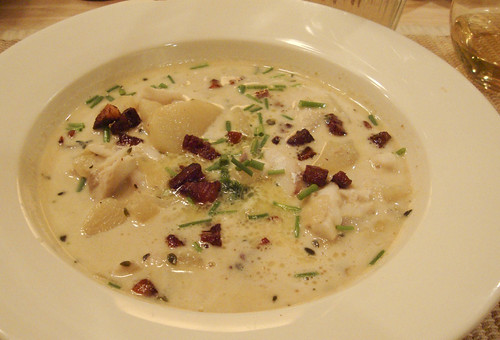
We've lost sight of what a good fish chowder** is. Too frequently chowder is a restaurant dish: a gloppy, salty bowl of soup, lacking seafood flavor. It's usually clam chowder and it most likely comes from a can or a box in the freezer. Ironically, most of us can get reliably good seafood and a great chowder is well within our reach.


Go make this chowder. It's perfect for a cold night and we've got quite a few of those coming up. This recipe is liberally lifted from a recipe by Jasper White. For those of you who don't know Jasper White, or know of him only through his Summer Shack restaurants, I'll point out that he was a major force in Boston's restaurant scene in the '80s and '90s. When Dave and I first moved to Boston, a table at Jasper's was an experience to celebrate. We ate there a few times (in fact, we were even going to get engaged during dinner there, except I got a stomach bug and the proposal we held over until the follow day. I said yes by the way. :-) ).

Fish Chowder
Serves 4

Fish chowder seems like a rather boring name for this dish because it is fantastic. All through dinner we just kept marveling over the flavor. Use the freshest fish you can find. I used a side of pollock from our latest community supported fishery delivery and it was fabulous. I also had some fish broth (fumet) in the freezer from this summer's CSF share, but feel free to use a light chicken broth, clam broth or just plain water.

This recipe is easily doubled or tripled to feed a large group.

This looks like a long recipe, but it takes about 30 minutes, start to finish, and about 15 of that is unattended time while the potatoes are cooking.

  • 2-4 ounces salt pork or bacon
  • 1 medium onion, chopped (about 1 cup of chopped onion)
  • 2 teaspoons fresh thyme leaves, or 1/2 tsp dried thyme
  • 1 pound russet potatoes, peeled and cut into 1/3" thick slices (cut the potato slices in half or quarters if they're bigger than soup spoon size)
  • 2-3 cups fish broth, chicken broth, clam broth and/or water
  • 1 pound skinless fish fillets (try cod, pollock, haddock, hake, etc. any mild white fish will do)
  • 1/2-1 cup heavy cream
  • salt and pepper to taste
  • chopped chives, parsley, fennel and/or dill
Chop the salt pork or bacon into 1/4" dice. Put the pork into a large saucepan or soup pot and cook over medium-low heat until the cubes are starting to crisp and about 2-3 tablespoons of fat have rendered out (this will vary depending on what kind of pork you're using). Raise the heat and cook the pork cubes until they're crispy. Remove the crisped pork from the saucepan and pour off some fat if a lot has rendered out. Reserve the pork for serving time.

Add the onion to the pot and saute in the pork fat, adding a little butter or olive oil if the pan is too dry. Cook until the onion is soft and just starting to brown. Add the thyme and the potatoes. Add enough stock or water to just cover the potatoes (I needed only 2 cups). Bring to a boil and them reduce the heat to keep everything simmering. Cook until the potatoes are soft enough to crush against the side of the pot, about 10-15 minutes. Check the seasoning and add salt and pepper to taste.

Add the fillets to the pot and stir them gently into the soup. Keep cooking on low heat until the fish is cooked through enough to break into large flakes when you stir (the fish isn't cut into chunks before it goes in the pot - the cooking process will allow the fillet to break into bite-sized pieces). When the fish is cooked through, add the cream - adjust the amount to your taste: I used about 1/2 cup of cream in ours and it was rich enough for a weeknight dinner. Recheck the seasoning and adjust with salt and pepper to taste (I like a fair amount of pepper in this).

Ladle into bowls and garnish with the crispy pork and chopped herbs.


** An aside: I can't think or write the word "chowder" without thinking of The Simpsons episode where Freddie Quimby tries to get the family's French servant to say "chowder" properly. Dunno what I'm talking about? Here you go:


Sunday, November 8, 2009

Arctic Char with Lentils and Mustard Beurre Blanc

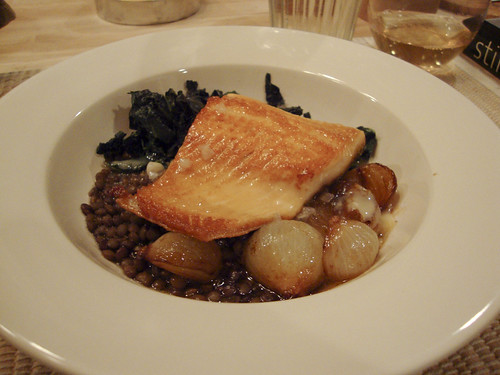
This is another recipe (with a lousy picture, sorry) I have been meaning to post for you for a while. Arctic char is not a fish you may think of right off the bat, but it's a great fish to seek out and cook with. Char is similar to trout or salmon (they share a family tree) and can be safely substituted in most recipes calling for either. The char you will find for sale is likely farmed and will be a product of the United States, Canada, Iceland or Norway. Check out the Monterey Bay Aquarium's Seafood Watch site for more info on choosing sustainable seafood options.

This recipe is part of Teach a Man to Fish, an online event focused on drawing attention to the problem of overfishing and to cooking with sustainable seafood. In its third year, Teach a Man to Fish is organized by the lovely Jacqueline Church. Visit her site here for more information and lots of recipes and seafood info.)

This dish has lots of components: the fish, the sauce, lentils, kale and onions. Everything but the fish and the sauce can be made ahead (even a few days ahead), and you can just use a few components instead. For instance, the char and sauce would be nice over pasta or rice. I'm going to to give the components as separate recipes so you can decide what to use.

All recipes serve four people. I plated my dish with lentils in the bottom, kale and onions on the sides. Then I placed the char on top with a healthy dollop of beurre blanc to melt over the plate.

  • 1 1/2 pounds Arctic char fillets, cut into four pieces of about 6 oz. each
  • salt and pepper
  • oil for pan
Heat a 12" skillet, preferably not non-stick, over high heat. While the pan is heating, prepare the fish fillets: lay them skin-side down on a sheet of paper towels to ensure the fillets are really dry. Sprinkle the flesh with salt and pepper. Pour a little oil in the very hot skillet and lay the fillets skin-side down in the skillet. Sear the fillets about 3 minutes, until the skin is browned and crisp. Carefully turn the fillets and cook another 3-4 minutes until the fillets are cooked through.

Mustard Beurre Blanc
  • 1/2 cup white wine
  • 1 shallot, minced fine
  • 1 tablespoon dijon mustard
  • 8 ounces (yes, that's two sticks) unsalted butter, cut into small pieces
  • salt to taste
Put the wine and shallot in a small saucepan and boil over medium-high heat and reduce to 2 tablespoons. Whisk in the mustard.

Whisk in butter, piece by piece. Don't add all the butter at once, you need to emulsify the sauce with the butter, and you won't succeed if you try to rush it. Whisk vigorously, adding each piece as it's absorbed into the sauce. When all the butter has been added, season sauce with salt to taste.

Keep sauce warm until time to serve.

Lentilles du Puy
  • 1 cup lentilles du Puy (see my lentil posts here and here for more info on this type of lentil)
  • 1 small onion, diced
  • 2 cloves garlic, sliced thin
  • sprig thyme
  • olive oil
In a medium saucepan (3 quart-ish) over medium heat, saute the onion and garlic until softened and just starting to brown. Add the lentils and stir to coat with oil. Add 2-3 cups water and the thyem and bring to a simmer. Simmer until lentils are cooked through. Depending on the age of your lentils, they will take from 20-45 minutes. Add more water as needed; you want the lentils to stay covered with water while they cook.

When the lentils are tender, remove them from heat. Season with salt and pepper.

The lentils can be made several days ahead and reheated when you need them.

Braised Kale
  • 1 bunch kale, leaves pulled from stems, leaves cut into thin strips
  • 2 cloves garlic, sliced thin
  • oil for sauteing
  • sherry vinegar
Saute the garlic until it starts to soften, add the shredded kale and a sprinkle of salt. Saute over medium heat until the kale is wilted and soft. If the kale starts to stick, or the pan seems too dry, add a splash of water. Season to taste with salt and a splash of sherry vinegar.

Caramelized Onions
  • 10-30 small onions (cippolini or boiling onions - judge how many you need by their size: they're garnish, not a side dish), peeled and halved through the stem end if large.
  • 1 -2 cups chicken broth
  • 1/4 cup sherry vinegar
  • brown sugar
  • olive oil
  • salt and pepper
Saute the onions in a skillet large enough to hold them in one layer. Let them brown gently over medium heat, about 10 minutes. Pour enough chicken broth onto the onions to cover them halfway. Partially cover the pan. Simmer until onions are soft all the way through. Remove cover from pan, turn heat up and boil until the broth is reduced to a glaze.

Deglaze the pan with vinegar and add a sprinkle of brown sugar to make a glaze that coats the onions. Taste: if things are too vinegary add a little more sugar. Add salt and pepper to taste.

Saturday, November 7, 2009

Fried Smelt Po'Boy

This meal came together as the result of a plan-free shopping trip to Whole Foods. I wandered past the seafood display and saw a tray of fresh smelt (smelts?) on display. I've been trying to cook more sustainable seafood and these seemed like a great option to work with. For some reason, the idea of a smelt po'boy came to me. Inspiration-struck, I hustled through the store and picked up the remainder of what I thought I'd need to make supper: a baguette, a few tangerines (trust me) and a lemon.

The plate would have looked more than a little tan, so I included a salad in my meal's design to keep scurvy at bay.

Fried Smelt Po'Boy with Fennel-Chicory-Tangerine Salad
Disclaimer: I have never eaten a real po'boy, so I make no claims to the authenticity of my sandwich. All I can say is that it was delicious.

This looks like a lot of components, but don't worry: this all came together really fast. Also, there's nothing wrong with using regular tartar sauce, plain butter, skipping the salad, etc.

Makes enough for two servings:

For fish
  • 12 ounces gutted, cleaned smelts (don't worry about the bones - they'll soften up during the frying and will be 100% edible)
  • Wondra flour, for dredging
  • Oil for frying
For fennel-lemon tartar sauce
  • 3 tablespoons mayonnaise
  • Zest of 1 lemon
  • Chopped fennel fronds
  • Hot pepper flakes, to taste
For mustard butter
  • 2 tablespoons butter
  • 2 tablespoons creole mustard
To finish sandwich
  • 12" baguette, cut into 2 pieces and sliced lengthwise (like a book)
For salad
  • Fennel bulb
  • 1 tangerine or clementine
  • 2 handfuls shredded chicory
  • sherry vinegar
  • olive oil
  • salt & pepper
Make tartar sauce: Mix all ingredients together and adjust salt, heat and acid to your taste.

Make mustard butter: Blend butter and mustard together.

Make salad: Thinly slice fennel bulb (a mandoline is great for this). Peel and section the tangerine into segments. Toss fennel and tangerine segments with chicory. Sprinkle a few tablespoons of sherry vinegar over the salad and then a few tablespoons of olive oil. Toss to combine, adding salt and pepper to taste.

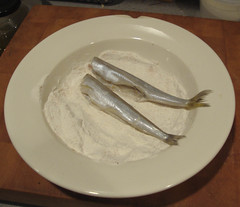
Fry the fish: Heat 1/2" oil in frying pan. Dredge the smelts in Wondra flour. When oil is hot (sprinkle a little flour into oil - it should sizzle up and brown quickly), fry the fish in batches until lightly browned. Remove fish from pan and drain on paper towels. Let the oil come up to heat again before frying more fish. (I fried mine in two batches.)

Assemble sandwich: heat the baguettes in a 300 oven until warm and crusty. Spread the inside of the bread with mustard butter. Fill each sandwich with fish (leave some tails poking out the ends, for fun). Sprinkle fish with salt and a squeeze of lemon juice. Top with tartar sauce. Serve with salad alongside or stuffed into the sandwich as you prefer. (We kept our salad on the side and stuffed a little in every now and then.)

(Edited to add: This recipe is part of Teach a Man to Fish, an online event focused on drawing attention to the problem of overfishing and to cooking with sustainable seafood. In its third year, Teach a Man to Fish is organized by the lovely Jacqueline Church. Visit her site here for more information and lots of recipes and seafood info.)

Thursday, April 16, 2009

Ouzo-Spiked Shrimp

This is a great "what the heck's the dinner tonight?" dish. Everything you need to make it comes from the freezer or kitchen cabinet, if you've got a little fresh greenery for garnish, all the better!

Ouzo-Spiked Shrimp
Serves 4
Recipe notes: I used ouzo to deglaze the pan and add a fennel flavor to the dish, but you can use white wine, rum, tequila or dry vermouth instead.

If you prefer, you can leave out the chickpeas and double the amount of shrimp.
  • 1 onion, chopped
  • 3 cloves of garlic, minced
  • 1/4 cup ouzo
  • 1 28 oz. can of plum tomatoes, tomatoes chopped or torn into pieces
  • 1 15 oz. can chickpeas, drained
  • 2 tablespoons capers
  • 1/2 pound of shrimp
  • minced herb for garnish, optional
In a large skillet, over medium-high heat saute the onion and garlic with a little olive oil until softened and a barely golden. Deglaze the pan with the ouzo, scraping any bits off the bottom of the pan. Let the alcohol boil off until the pan is almost dry.

Add the tomatoes to the pan. Bring to a simmer and let simmer until a little thickened. Taste for seasoning and add salt or pepper as needed.

Stir the chickpeas, capers and shrimp into the pan. Simmer until the beans are warmed and the shrimp are cooked through.

Serve with rice, pasta or a big hunk of fresh bread.

Monday, March 2, 2009

Ouzo-Cured Salmon

Ouzo-haters, don't turn away!

I made this salmon, recipe originally found here at Kalofagas, for a Meet Up (Eat Up!) at WBUR in conjunction with their Public Radio Kitchen project. The Public Radio Kitchen provides a great aggregation of Boston-area food and restaurant blogs. The Eat Up was the first opportunity (for large a number us) to meet in person. I offered to bring along a large spread of food for the attendees. A few other folks brought treats as well, and in occurrence similar to the miracle of the loaves and fishes, we all got plenty to eat! Some pictures from the event are here.

Here's the full menu of what I provided for the event:
  • Ouzo-Cured Salmon with Carrot Tzatziki
  • Lentil Salad with Roasted Kohlrabi and Caramelized Onions
  • Roasted Beets with Skordalia (Potato-Garlic Sauce)
  • Butternut Squash Baklava (savory, not sweet)
  • Rosemary Foccacia
  • Citrus Salad with Pickled Shallots, Kalamata Olives and Arugula (Sunday's cover shot)
I thought I'd share some of the recipes with you, starting with the salmon. The hardest parts of this dish are finding really high quality salmon (let your fish guy or gal know that you'll be curing it and that you need great quality product) and slicing it thinly enough (sharpen that knife!) when you're ready to serve it. This recipe can scale (no pun intended) up or down, depending on the size of the fillet you're using. The ouzo flavor isn't prominent, it just provides a nice herbal note to the salmon.

Ouzo-Cured Salmon
For appetizer servings, plan on 2 or 3 ounces of salmon per person.
  • Salmon
For every pound of salmon you use:
  • 3 tablespoons ouzo (or vodka - if using vodka and you still want an anise flavor, add 1 tablespoon aniseseed to the cure mixture)
  • 2 tablespoons kosher salt
  • 2 tablespoons sugar
  • 2 teaspoons coarse-ground black pepper
  • zest of one orange
  • zest of one lemon
  • 1 teaspoon Aleppo pepper flakes
Put the salmon, skin-size down, on a large sheet of plastic wrap in a container large enough hold the salmon in one flat layer (The salmon will exude more liquid - make sure the dish you're using has sides high enough to contain any drips: rimmed baking sheet, roasting pan, large Tupperware container, etc.).

Drizzle the salmon with the ouzo. Mix together the remaining ingredients and rub on the flesh. Wrap the plastic around the fillet tightly, trying to keep the liquid inside the plastic. Cover the fish with a cookie sheet, plate or some other flat item (you want to weight the fillet down, so make sure it's entirely covered. Weight down the sheet with a heavy item (a can, bag of flour, cast iron skillet, etc.) . Place the salmon in the refrigerator for one to three days (the flavor gets stronger the longer it cures).

Unwrap the salmon and pat it dry. Using a very sharp knife, slice very thin slices across the fillet. Garnish with citrus (I used kumquats and some dill fronds). Serve with carrot tzatziki.

Carrot Tzatziki
This is a play on the more traditional cucumber tzatziki. To make a cucumber version, substitute 1 cup of shredded, drained cucumber (about half an English cucumber - the one that's wrapped in plastic in the supermarket). This recipe is adapted from The Greek Vegetarian by Diane Kochilas.
  • 2 cups thick Greek-style yogurt (Fage is a good brand. Trader Joe's sells one too)
  • 2 medium carrots, shredded
  • 1-2 cloves of garlic, pressed or minced
  • 1/4 cup chopped dill
  • juice of 1/2 lemon
  • salt and pepper to taste
Mix all the ingredients together. Adjust salt to taste. If you need more tartness, add a little more lemon. As the tzatziki sits, the garlic flavor will become more pronounced. For best results, make this the day you intend to serve it.

Monday, September 15, 2008

Clam and Sausage Stew

This picture does not do this dish justice. (I really have to work on my food styling. Does anyone have any tips on how to get your food looking gorgeous when you are starving and just want to eat it? Anyhoo ...)

This dish was inspired by a traditional Portuguese dish of pork and clams. In that dish, the pork is usually shoulder meat that has been braised tender before the clams are added. I thought sausage would be a fast, easy, non-braised substitution.

One mandatory side for this brothy dish is crusty bread. We used a big loaf of ciabatta from Anna Rosa's bakery in Newburyport to soak up the juices. Delicious!

A word about clams: Most people are familiar with hardshell clams. Hardshells are graded by size: countnecks, littlenecks, topnencks, cherrystones, quahogs (from smallest to largest). In this dish, I prefer the smaller clams called countnecks (although littlenecks and topnecks can be used). Cherrystones are usually eaten raw or stuffed and baked. Quahogs are used for chowder. You may also see softshell clams in your market. Softshells are usually served steamed with clam broth and butter. You could use steamers in this dish if you wish, but they would not be my choice. If you've never eaten steamers, this is not the dish with which to make your introduction to them.

Clam and Sausage Stew
Serves 2 (generously) - 4 (as a starter)
  • 1 pound Italian sausage, sliced into 1/2" thick rounds
  • olive oil for sauteing
  • 1 small onion, chopped
  • 3 cloves garlic, pressed or minced
  • 1 1/2 cups diced tomatoes, with juice and seeds (if fresh tomatoes are not available, use canned, diced tomatoes)
  • 2-3 pounds hardshell clams, shells scrubbed
  • 3 tablespoons butter
  • 2-3 tablespoons minced fennel fronds, dill, cilantro or parsley
In a large skillet over medium-high heat, saute the sausage until cooked through. You may need to add some olive oil to lubricate the pan and keep the sausage moving around. Remove the sausage and set it aside while you make the rest of the dish.

Drain off the sausage fat if there's a lot of it. Add a little olive oil to the pan and saute the onion and garlic until softened. Add the tomatoes and cook over high heat until they break down to a saucy consistency.

Add the sausage back to the pan. Add the clams and butter to the pan and cover the pan. The clams will start to open in about 3 minutes or so. Keep and eye on the pan and when all the clams are open, add the minced herb. If a clam does not open, remove it and throw it out.

Taste the sauce for salt and add some if necessary. The liquid that clams give off tends to be fairly salty so you may not need any additional salt.

Dish the stew up into bowls and serve with a crunchy green salad and some crusty bread.

Thursday, July 17, 2008

Pastis-Marinated Shrimp

For the most recent Root Source Challenge (Pastis) I played with several recipes before deciding which to submit. I ended up sending in a recipe for Cornmeal and Pastis Cookies. But I think this shrimp recipe came out really well also. The pastis wasn't overpowering: there was just a hint of anise flavor. I amplified the flavors with ground anise and fennel seeds and some chopped fennel fronds.

I served it with grilled panisses. Panisses are made of chickpea flour, cooked with water (sort of like polenta) and seasoned with salt and olive oil. Typically, the cooked batter is poured into a flat sheet to cool and then cut into french-fry shapes. There were recently panisse discussions at David Lebovitz's blog here and here. I used his recipe for the panisse batter.

I decided to try treating panisses like polenta. After I cooked the batter I poured it into small loaf pans to cool. When cool and firm, I sliced, oiled and grilled. My dinner companions and I were happy with the results. The slices held together well and the grilling gave it a nice smoky flavor. I suggest you give both ways a try.

But that's not what this post is about ...

Pastis-Marinated Shrimp
2-4 servings, depending on what you're serving them with.

For the marinade:
  • 1/4 cup pastis (I used Ricard pastis. I think ouzo would work well too.)
  • juice of 1 lemon
  • 3 garlic cloves, minced or pressed
  • 1/2 cup olive oil
  • 1 teaspoon anise seed, crushed
  • 1 teaspoon fennel seed, crushed
  • 1/2 teaspoon salt
  • pinch of hot pepper flakes
  • 1 pound shell-on shrimp (my shrimp were large: 21-25s)
  • 2 tablespoons chopped fennel fronds for garnish (optional)
  • lemon wedges for garnish
Combine the marinade ingredients in a bowl or gallon-size Ziploc bag. Add the shrimp and rub the marinade into them. Let the shrimp rest in the marinade for 30 minutes to an hour.

Prepare your grill. Skewer the shrimp (you may use a grill basket instead of skewers) on bamboo or metal skewers.

Grill shrimp over medium-high heat until cooked through - about 5-7 minutes, depending on the size of your shrimp.

Serve on or off the skewers, sprinkled with fennel fronds and with lemon wedges on the side.
Blog Widget by LinkWithin