Saturday, March 21, 2015

I got wastED and the hangover is delicious

Awareness of "food waste" has become the topic of the day in my world. I know that I live inside a small bubble of food-loving and -obsessed people. Concerns about the volume of food that ends up in landfills as opposed to on our plates have become a major topic for discussion. I have a lot of imperfectly-formed thoughts on this subject and am reserving those until I feel I have developed a more articulate thesis. 

That said, when I heard that Dan Barber, the chef of Blue Hill and Blue Hill at Stone Barns, was going to host a "popup " series focused on this issue I was really intrigued. Then, when I realized that an already scheduled trip to NYC would coincide with the series, I was in. 

The conceit of wastED is to challenge chefs and purveyors to find uses for food that is normally diverted from the "food stream." (My words, not his.) The extensive a la carte menu offered 21 dishes, all comprised of ingredients that would have either ended in landfill/compost, dog and cat food, or run down the drain. All dishes were priced at $15, which removed one decision-making variable.

I was dining solo, so I made an effort to try a variety of dishes while ordering too much. The irony of wasting food at a food waste-awareness dinner as a result over-ordering was not lost on me. So, here follows a summary of my experience. I took photos for my own reference, but they are really not suitable for sharing (so dark in there!). 

I'd never dined at Blue Hill, but just walking in the door, I could tell that the restaurant had been transformed visually from its usual fine-dining look. My experience as a gardener told me that the walls and banquettes had been draped with Reemay, a row cover that I float over my garden to protect it from frost. It created an ethereal, cocoon-like effect. Knowing the intention of the event, I have no doubt that it will be reused back on a farmer's field later this spring.

The tables were set with resprouted vegetables--celery and bok choy plants had been regrown from their root ends (Cut a head of celery or choy about 3/4" from the bottom. Rest that root nub in water and a new plant will regrow. Pretty neat, yes? And very pretty.). Tables were laid with brown paper and set with a candle. The tabletops were made of mushroom growth medium (mycelium, think mushroomy styrofoam) and a fiberboard top made of some post-consumer product (I didn't get the actual product name, but will). 

Onto the food and drink. I'm providing the menu descriptions as written by wastED.


I started with "The Boiler Maker: MacKenzie bourbon infused with walnut press cake (byproduct of nut oil production) infused bourbon, flat beer syrup, spent coffee grounds bitters." It was a nice take on a Manhattan, served up in a rocks glass so the aromas really concentrated. After my cocktail was gone, I moved to rosé (Matthiasson, Napa, 2014) for the rest of the meal.

Bread was presented at table: two hearty slices of spent grains bread (made from the grain left after beer brewing). The bread was served with two small dishes: one containing whipped lardo and cracklings, the other held salt, pepper and rosemary. The server picked up my candle and poured the melted wax over the salt and pepper. He turned the candle and I could see it was labeled "beef." It was tallow, and it my candle had become part of the bread course. This was probably the most "tricksy" thing I saw all night, and it delighted both me and the server, who told me he just loved that reveal moment. And it was delicious. The tallow got a little toasty from the candle flame. I'm a huge lardo partisan, but that beef fat won (and stopped) my heart.

"Stew of kale ribs: pockmarked potatoes and parsnips, shaved immature egg yolk." This was a creamy stew (it reminded me a lot of a soubise, the classic French onion-rice sauce). Beautifully cut batonets of potato and parsnip and thin kale stems. I'll confess that I wanted more kale, but it was nice to see something that I think of as a very fibrous ingredient become so tender. The immature egg yolk was a fun touch. When a laying hen is slaughtered, she will frequently have eggs "in process" internally. These yolks look just as you'd expect. They were cooked (I'm guessing cured, actually, though I forgot to ask.) and then the servers microplaned a small shower of the yolk over the stew.

"Monkfish wings: brine from the olive bin, trial fish pepper hot sauce." According to the extensive glossary provided on the menu, monkfish wings are the bones attached to monkfish fins (I had originally thought that what I was served was actually collar, but the menu tells me otherwise). Monkfish is a species that even a nose-to-tail chef like me almost never sees head-on. There is little market value in the head, so most fisherman toss the head and fins overboard to save space in the hold. The wings were deep fried and served with a little squeeze bottle of hot sauce. I worked with fish peppers a few years ago for a special event, and my fingers tingled with phantom pain (way back when, I didn't wear gloves and the capsaicin kept my fingertips humming for days after the event). There was a surprising amount of meat on the wings, and like the tail meat we are more familiar with, it was succulent, almost a bit springy.

"WastED special: April Bloomfield remains of fins and field: local mackerel and fluke trim, red wattle trotter and head, lacto-fermented pulp, pickled vegetable scraps." This dish was served in a shallow bowl, and a fish broth was poured around the contents at table. Elements included a pair of fish balls (no, not that kind of fish balls!) made from fluke and mackerel. They were a little bouncy, not in an unpleasant way, and they were a nice contrast to the crunchy fried mackerel tail that garnished the plate, the broth was very delicate and let the flavor of the garnishes, the fermented pulp and shreds of pork, show through.

"Rotation risotto: second-class grains and seeds, squash seed pulp, pickled peanuts, spent cheese rinds." I was so excited to see this dish on the menu. Chef Barber spoke at Edible Institute last year, and he described this dish as the starting point for his musings on "use it all." The "second-class" grains and seeds referred to are the grains that his farmers grow on their field as part of crop rotations. In order to build up soil fertility and variety of grains and legumes are grown and then tilled in. His farmers are now harvesting some of that food before he plants are returned to the soil, and these grains make up the base of the dish. To me, this is one of the most exciting dishes on this menu. It represents a way in which farmland can be used to produce food year-round, and provide positive inputs to the soil without the addition of supplemental fertilizers.

"Dog food: unfit potatoes and gravy." As the menu tells us, this dish was inspired by the dog food produced by Dickson's Farmstead Meats. They use their unsellable offal cuts to produce a sellable product, dog food. Barber fleshed out (pun unintended) this rich meatloaf-like dish with the meat from a seven year-old dairy cow (when dairy cows are "retired" from service, they frequently are sold for dog food, as they are not seen as fit for human consumption). The dish was garnished with a little snowdrift of potato rissole (appropriate because it was snowing all through dinner). This plate was delicious, but very very rich.

To cap off my meal, I concluded with "Double whey bread pudding: whey caramel, roasted reject apples, cacao pod husk whey sorbet." I opted for a option in which pork blood was substituted for the cream in the pudding custard. That option gave me a reverse supplement: I got 95 cents off for going "bloody." I really enjoyed this dessert. The sorbet had a very robust chocolate note from the husks (which gardeners would also recognize as the cocoa hull mulch you can by buy at garden centers). The pig blood gave dessert a rich, very savory note. I could imagine it being off-putting to some, but the apples brought enough acidity to counteract the "porkiness."

If you live locally, I strongly urge you to make the time to visit this event before it ends in a week. Some of the dishes do seem overly designed so as to use as much "waste" as possible, but the results were consistently excellent. The dinner series is reservation only before 9, with walk in tables available later in the evening.

This conversation should and will continue. I am very excited to see how we can bridge the gulf that lies between educating those of us who can afford a dinner like this one, and those who are actually going hungry. If wastED keeps us talking, and keeps us thinking creatively about diverting food from the waste stream, all the better.


I

Tuesday, February 25, 2014

Tegame, part due

Ok, so I didn't post it here. But, here's a redux of my Tegame alla Vernazzana recipe from a few years ago, posted over on Food52. I think it's much more interesting than the older recipe.

Enjoy!

Thursday, January 16, 2014

Returning to the Kitchen

Hi there. It has been a long time, hasn't it?

A lot has happened in my life since the last time I was here. Details and reflections on that to come, I think. But I thought it was a little bit of kismet that I came back to my blog today, exactly 3 years from my last post, to figure out what to cook this week.

Back soon.

Sunday, January 16, 2011

Charcutepalooza: Whole Wheat Pasta with Braised Cabbage & Duck Prosciutto

Pasta with Braised Cabbage and Duck Prosciutto

Trying something new here, since I don't have time to pull together full recipes for you right now, but this dish was so good that I had to share. The hazelnut breadcrumbs are gilding of this lily, but they are quick to make and really add a great textural contrast to this dish.

This was good people, really really good. The whole time we ate we made yummy noises. (There may have been some grunting.)

If you don't have duck prosciutto at hand, sub in a great ham (country ham would be fabulous), cooked bacon, or traditional prosciutto (domestic would ok).

So here you go, step-by-step:

Brown one large onion, sliced thin, in a large skillet.

Pasta with Braised Cabbage and Duck Prosciutto

Add about 1/2 of a savoy cabbage, sliced thin, and about 1/2 cup of water. Cook over medium heat until cabbage is softened.

Pasta with Braised Cabbage and Duck Prosciutto

Add two large dollops of creme fraiche and a sprinkle of salt.

Pasta with Braised Cabbage and Duck Prosciutto

Stir once or twice and cook until it looks like this. Add a little water if the skillet gets too dry; you want things to stay semi-soupy. When it's done to your liking, grind in a crap-ton of black pepper and turn off the heat until the pasta is ready.

Pasta with Braised Cabbage and Duck Prosciutto

Meanwhile, cook up about half a pound of whole wheat spaghetti.

Pasta with Braised Cabbage and Duck Prosciutto

When the pasta is cooked to your taste (I like whole wheat pasta to be just this side of underdone, because it will finish cooking in the skillet *and* because when it overcooks, it gets soggy), reserve a cup of the cooking water (that's the mug is for: to remind me to save some water) and drain the pasta.

Pasta with Braised Cabbage and Duck Prosciutto

Toss the pasta into the skillet and turn the heat back on. Stir and toss the pasta together with the cabbage, adding some cooking water if it's too dry.

Pasta with Braised Cabbage and Duck Prosciutto

Fold in about 1/2 cup of duck prosciutto, slivered.

Pasta with Braised Cabbage and Duck Prosciutto

Serve in warmed soup plates, topped with hazelnut breadcrumbs.


To make the breadcrumbs:

Put a handful of hazelnuts into a mortar.

Pasta with Braised Cabbage and Duck Prosciutto

Crush them and toss them into a small pan with an equal portion of panko or fresh breadcrumbs. Drizzle in some olive oil and toast over medium high heat until browned and crispy.

Pasta with Braised Cabbage and Duck Prosciutto

Saturday, January 15, 2011

Charcutepalooza: Month One

So, over New Year's my friend Mrs. Wheelbarrow and new friend Yummy Mummy had a spark that grew into a massive meaty conflagration: Charcutepalooza! We're going to take on various charcuterie projects over the course a year. With my major project on deck: y'know, opening a restaurant, I'm going to do my best keeping up but don't think I'll be able to do every project.

You can get on board too! Check out the Charcutepalooza page for information on how to get started.

In month one we made duck prosciutto. I purchased whole ducks and broke them down for the breast meat (oh yes, on Twitter the breast jokes were never-ending). I made confit from the legs with the fat rendered from the carcasses.

The prosciutto making was the easy part: you bury the breasts in salt night, then rub them with spices, then hang them for 7 days. Done!

For me the biggest challenge was finding a spot in the house that had the right combination of temperature (50-60 degrees) and humidity (70% ish). My prosciutto ended up a little dry and I'm sure it's because of the humidity level (too low).

I rubbed two of my breasts with white pepper and the other with a fennel-black pepper-coriander mixture. To be honest, I didn't taste much of a difference between the two. Next time I might try heavily crusting it with black pepper for a more pastrami-esque experience.

So far, we've eaten our prosciutto alongside a citrusy fennel salad and over the top of a chickpea soup. For the soup, I tried crisping the prosciutto, and for me this wasn't super successful: the prosciutto got saltier and lost a lot of its nuanced flavors.

Next month: Pancetta!

Thursday, November 4, 2010

So it's been a while ....

Kale Pesto and Glamorous Chickpea SoupSorry folks, vacation, family and business have taken my attention for the last few months. But I am so excited to tell you about why I haven't been posting: My husband and I are opening a restaurant!

Enzo Restaurant & Bar is something we've been planning for a long time. We'll be sharing our passion for great food with our community. We'll be serving dishes inspired by Northern Italy but interpreted back through New England's seasons and ingredients. Imagine if your grandmother came to Massachusetts from Genoa and had to prepare meals for her family. She'd use what she had available to her locally to make the dishes of her homeland.

Ciao for now!

Saturday, September 4, 2010

Use Your Booty: Barley Salad with Burrata

Black Barley Salad

I meant to to get this post up before this holiday weekend started. This salad is a great healthy, vegetarian, colorful side dish that goes well alongside grilled meat. It also improves with age - so you can make it a day or two ahead. I fancied it up with a large chunk of burrata cheese - feel free to omit it if you prefer.

Black Barley Salad with Burrata
Serves about 8-10 as a side dish, makes a generous 4-6 main course servings.
I liked the richness added by the burrata - if you don't have any at hand, fresh mozzarella, goat cheese or ricotta salata would be great. Or go dairy-free and toss on slices of hard-boiled egg.
  • 1 cup uncooked black barley or 4 cups cooked barley (or pearl barley or "regular" barley - this salad would also work with farro or wheatberries)
  • 2-3 small zucchini, diced
  • 2 large tomatoes, diced
  • 2 handfuls purslane leaves
  • 1 small onion, sliced into thin rounds
  • red wine vinegar
  • olive oil
  • salt and pepper
  • 8 ounces burrata, left whole (preferred) or torn into shreds
Cook the barley, if needed: pick through the uncooked grains to remove any stones or bits of twig or chaff. Place in saucepan and cover with water by two inches and bring to boil. Reduce heat to a simmer, add a healthy pinch of salt and cook until the grains are tender. This will take from 45 minutes to 2 hours, depending on the grain you're cooking and how old it is. Add more water as needed to keep the barley covered.

When the barley is cooked, drain it in a colander and set aside to cool.

Toss half of the cooked barley with the vegetables. Add more barley until you have the vegetable/grain ratio you like. (You may not use all of the barley. Any leftovers can be frozen for future use.)

Sprinkle the salad with red wine vinegar and a healthy glug or two of olive oil. Season to taste with more vinegar and oil and salt and pepper. Top the salad with burrata and serve.

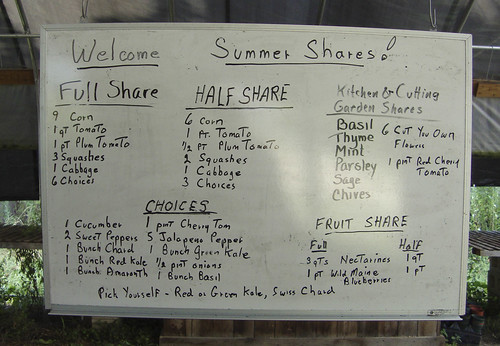
This Summer, I am chronicling my first CSA (Community Supported Agriculture) experience. My CSA share is from Arrowhead Farm, a farm based in Newburyport, MA. Each week, I am posting about what was in my share and what I'm doing with it. By way of full disclosure, I won my share through a raffle and am not paying for it. However, Arrowhead did not know I was entered in the raffle, and I received no special consideration because of this blog. I paid for my livestock share. A full set of all the photos I've taken of this share is here.

Friday, August 27, 2010

The Porchetta Project

Porchetta - Carved Up
I have been dreaming of porchetta lately: a big roast of pork, redolent of rosemary and garlic and wrapped in crispy, crackly pork skin. This is a dish that's easy to get if you live in Italy, or near the eponymous shop in NYC, but up in my neck of the woods, not so much.

So what's a girl to do but take this porky problem into her own hands? Technically I needed what's called a "long middle" (a pork loin with the belly still attached), but my favorite pork supplier Tim Rocha at Kellie Brook Farm let me know that might be a tough cut for him to get. So, I decided to cobble together Frankenpig from a loin, some fatback and a skin-on belly.

Porchetta - 1st layer - belly with rub
I made a rub of rosemary, garlic, black pepper and salt to use for seasoning the roast and got to work assembling the beast: I laid the belly out and rubbed it liberally with half of the seasoning. I laid the loin over it and rubbed on the other half of the seasoning. I took the fatback (I did trim it down as it was really thick, so it ended up with a piece that was about 1/3 inch thick ) and laid it over the top.

Porchetta - ready to roast
I then did a ridiculously poor job of trussing this amalgam into a cylinder. I put it onto a rack on a sheet pan and left it in the fridge for for a day, to let the rub's herbiness perfume the meat.

Since the roast was so thick (almost 10 inches) I took it out of the fridge an hour before I started roasting it. I followed the basic instructions that Molly Stevens used in her
porchetta project. Porchetta - first 30 minutesI put the roast into a 475-degree oven on a roasting rack on a sheet pan and let it crackle away for 30 minutes (this will create A LOT of smoke; turn off the smoke detectors first). Then the oven went down to 325-degrees and the porchetta roasted away for another 3 hours.

I popped into the oven every now and then and basted the skin with the fat that was accumulating in the pan. I also siphoned off a lot of this fat as it rendered. This was a necessary chore as a lot of fat rendered off: nearly 2 cups.

While this wasn't my perfect porchetta: it was a little too fatty, the loin on the ends was a little dry and the skin wasn't crispy all the way around. But, holy moly, it was a delicious. The skin that was crisped up was super crunchy and toothsome. The rosemary and garlic flavor permeated the meat and made for a great flavor. While the roast was resting, I roasted potatoes on a sheet pan with some of the rendered fat. We enjoyed our porchetta and potatoes with a fennel salad.

Porchetta SandwichTwo days later, we had an amazing sandwiches of gently-warmed porchetta, tomatoes and Swiss chard salad for dinner. Nom nom.

Changes for next time:
  • Remember to score the skin before you truss the roast - very very hard to score skin without cutting through the trussing twine.
  • Don't put the rub on the outside of the roast. I did and it started scorching up right off the bat.
  • Trim back a little more fat from the roast: a had a double layer of fat on the top (the loin fat against the back fat was too thick a layer).
  • Roll the roast during the skin-crisping stage to make sure that all the skin gets exposed to the heat.

Monday, August 16, 2010

Use Your Booty: Grilled Sausage Sub Platter

Grilled Sausage Dinner
Yesterday I asked Dave what he wanted for dinner and he sheepishly asked for sausage and pepper subs. I'm not a huge fan of this type of sandwich (and he knows it): the roll is always too big and fluffy, overshadowing the filling; the filling needs to be inserted perfectly, otherwise everything slithers out the back end when you take a bite; and frankly, I like to eat with a knife and fork most of the time.

So this was a great compromise: we took the traditional insides threw them all on the grill and served it all on a platter with fresh tomatoes, olive focaccia and some spicy kale (not in the picture) on the side.

I made garlic oil and brushed it on the peppers, onions and eggplant prior to grilling. I'll admit the eggplant is not traditional, but I love grilled eggplant and it stretched the sausage so we had enough left over for another meal. The peppers and kale came from my CSA and the eggplant from the farmstand down the road. The tomatoes were a gift from the lovely ladies at The Herb Farmacy (a fellow farmer's market vendor).

A note about the sausage: This sausage was INCREDIBLE. I got it from Tim Rocha at Kellie Brook Farm. His booth is two over from mine at the farmers' market, so I was able to do some shopping in between customers. I bought a pound each of his hot Italian and chorizo sausages. Last night we grilled the hot Italian sausage. It was everything you want sausage to be: fatty enough so it didn't try out on the grill (even though we had a fiery flareup or two), good seasoning (not too salty, just enough heat), and deep porky flavor. Seriously, we sat at the table, chewing the meat and saying over and over how good it was.

Tim raises Berkshire hogs and the flavor is just great: rich and porky with just enough fat (although it is a leaner breed than some other heritage breeds). In addition to Newburyport, MA, Tim also sells his meat (pork, chicken, veal) at markets in Portsmouth, Exeter and Hampton, NH.

This Summer, I am chronicling my first CSA (Community Supported Agriculture) experience. My CSA share is from Arrowhead Farm, a farm based in Newburyport, MA. Each week, I am posting about what was in my share and what I'm doing with it. By way of full disclosure, I won my share through a raffle and am not paying for it. However, Arrowhead did not know I was entered in the raffle, and I received no special consideration because of this blog. I paid for my livestock share. A full set of all the photos I've taken of this share is here.

Use Your Booty: Quick Pasta Dinner

Linguine with Tomato, Chard and Crispy Crumbs

What can I say? I'm a sucker for an egg and some crispy crumbs. If you've been reading this summer's posts, this dish may look a little familiar, but it's a nice go-to for when you don't know what's going on the dinner table. I boil some pasta, make a quick sauce of sautéed vegetables and top the plate with a poached or fried egg and some crispy bits. The crispy crumbs add a nice textural contrast to the plate.

This plate was: linguine and a sauce of bacon, chunks of plum tomato, and shreds of Swiss chard and onion. I drained the pasta (I lifted it out of the pot with tongs), and added it right to the skillet containing the sauce. Then I poached the eggs right in the pasta pot. In the meantime, the crumbs were toasting in the toaster oven with a little olive oil.

Dinner in about 15 minutes!


This Summer, I am chronicling my first CSA (Community Supported Agriculture) experience. My CSA share is from Arrowhead Farm, a farm based in Newburyport, MA. Each week, I am posting about what was in my share and what I'm doing with it. By way of full disclosure, I won my share through a raffle and am not paying for it. However, Arrowhead did not know I was entered in the raffle, and I received no special consideration because of this blog. I paid for my livestock share. A full set of all the photos I've taken of this share is here.

Saturday, August 14, 2010

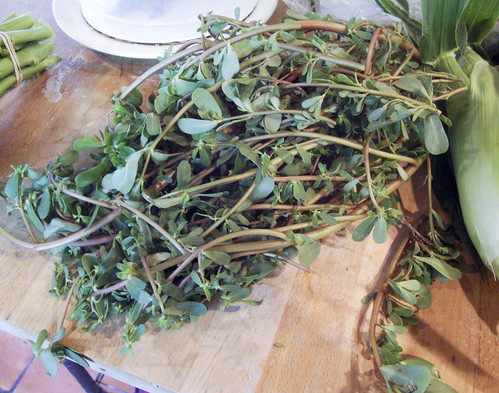
Ladies and Gentlemen, May I Introduce: Purslane!

When I stopped by to make my CSA pickup on Friday, I got an added treat: Purslane! Purslane has always been eaten in Mediterranean and Middle Eastern countries and has recently become a greenmarket darling. The nice thing for you and me is that purslane is also a weed. If your farmer doesn't spray his crops, ask if you can pick some purslane - as it's seen as a weed, he'll likely be thrilled to have you do it. Heck, if you have a yard, you've probably got some growing around the margins - purslane likes slightly bare, sandy soil.

When you get your purslane home store it, wrapped in a dishtowel, in a plastic bag. Before eating it, wash it well. Purslane grows really close to the ground so it can be super-sandy. If the stems are thin and not too fibrous (they should snap easily - like a fresh green bean) you can use them. If the stems are tough or stringy, strip the leaves from the stems and just use them.

Purslane, Squash and Jalapeno Salad
I like using purslane fresh in salads like this one here. It's a succulent leaf that holds up well to citrusy dressing and chunky partners like this summer squash. I chopped my bunch of purslane into 1/2" lengths and tossed it with sliced summer squash, chopped jalapeno and a lemon dressing.

In addition to using it fresh, you can quickly sauté the stems and leaves with garlic and chili. I have also pickled purslane stems and they're a great addition to a sandwich (use a dilly bean recipe).

This Summer, I am chronicling my first CSA (Community Supported Agriculture) experience. My CSA share is from Arrowhead Farm, a farm based in Newburyport, MA. Each week, I am posting about what was in my share and what I'm doing with it. By way of full disclosure, I won my share through a raffle and am not paying for it. However, Arrowhead did not know I was entered in the raffle, and I received no special consideration because of this blog. I paid for my livestock share. A full set of all the photos I've taken of this share is here.

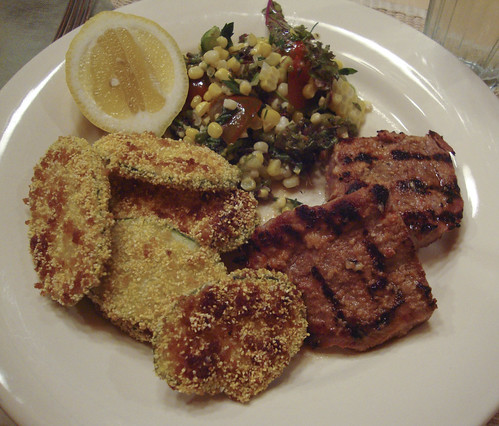
Grilled Goat Striploin

Last Sunday, the farmers' market was hopping! So much so, that I sold out of all of my baked goods with 30 minutes left to go before the closing bell. I took the opportunity to do a little shopping.

Riverslea Farm sells lamb and goat meat as well as wool products. I picked up two pieces of what they called goat "strips". After looking at the meat I figured out, I think, that this was the same cut as tenderloin: the muscle fibers ran the long way along the meat and the cut was shrouded in silverskin, line a tenderloin.

I trimmed the silverskin from the meat and then rubbed the meat with a spice paste made from:
  • 3 cloves garlic
  • 15 fenugreek seeds, toasted and ground
  • 1/4 tsp cayenne pepper
  • 1 tablespoon red wine vinegar
  • 1/2 teaspoon salt
We let the paste flavor the meat while the grill heated. We grilled the meat for about 4 minutes a side and dinner was done.

I made sure we cut the meat across the grain and it was wonderfully tender. Surprisingly, the flavor of the meat wasn't as strong as I expected it to be. I'm not sure if that was a function of the cut, the age of the goat at slaughter, or both.

CSA Booty - Week 13

Be sure to check out Use Your Booty: Show Your CSA Box Who's Boss for ideas about how to manage your CSA vegetables.

In this week's share I picked up:
  • 6 ears of corn
  • 2 pattypan squash, 2 yellow squash
  • 1 head of cabbage
  • Cherry and plum tomatoes
  • 4 Anaheim chile peppers
  • 1 bunch of broccoli
  • A whole pile of kale - picked my own!
  • 1 bunch of Swiss chard
  • A bunch of basil
  • A whole mess of purslane (more to come on this!)
So here's what I think I'm doing with these items:
  • I think I'm going to make a pudding with the corn.
  • The cabbage is going most likely become another slaw, maybe with the broccoli.
  • The plum tomatoes will get roasted and eaten either on pasta or perhaps on bruschetta.
  • I have two avocados ripening on the counter, so I'll like make chile rellenos with the peppers and spiced greens with some of the kale.
  • The cherry tomatoes have already gone into tomato pie.
So how'd I do with last week's haul? Here's what we ate from the CSA last week:
  • Half the corn was steamed and eaten hot with butter. Yum. The other half went into a salad with a few other vegetables.
  • I stuffed the Anaheims with Monterey jack and some thinly sliced onions. They went into a skillet and got all silky soft.
  • The cabbage made a slaw with a few other vegetables.
  • I fried some of the zucchini and the rest went into the corn salad.
  • I made this gorgeous tomato rarebit to test for Food52 with great tomatoes I had.
  • The plum tomatoes went into a pasta sauce with Swiss chard, onions and bacon.
This Summer, I am chronicling my first CSA (Community Supported Agriculture) experience. My CSA share is from Arrowhead Farm, a farm based in Newburyport, MA. Each week, I am posting about what was in my share and what I'm doing with it. By way of full disclosure, I won my share through a raffle and am not paying for it. However, Arrowhead did not know I was entered in the raffle, and I received no special consideration because of this blog. I paid for my livestock share.

Friday, August 13, 2010

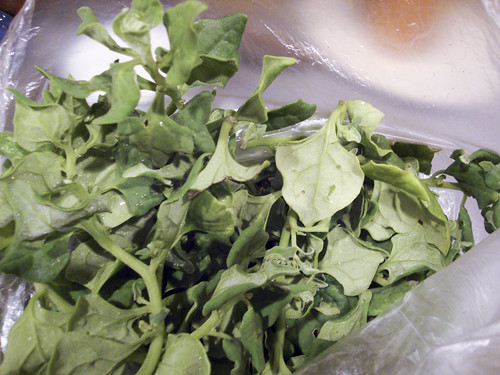
Ladies and Gentlemen, May I Introduce: Tetragonia!

Tetragonia, or New Zealand spinach, is a green that you may find at the famers' market this summer. It's gotten very popular with farmers and shoppers because it doesn't bolt (go to seed and turn bitter) like spinach when the temperature rises.

Tetragonia is not a member of the spinach family, but it tastes a lot like it. The leaves are slightly succulent - not quite as juicy as your Mom's jade plant, but still. As a result, when you buying it, you should make sure the leaves are bouncy/crispy without a hint of wilty softness.

To prepare it for cooking, strip the leaves from the stems and wash them well. Sauté like spinach; I like mine with lots of garlic and a splash of lemon or vinegar. Not that Tetragonia has quite a bit of oxalic acid in it (like spinach and chard do), so your teeth may get that sandy feeling after eating it. It's also why I don't like eating tetragonia raw: I find the oxalic acid sandiness is diminished when the vegetable is cooked. Also, because oxalic acid isn't super-great for your liver in general, don't go eating this stuff at every meal.

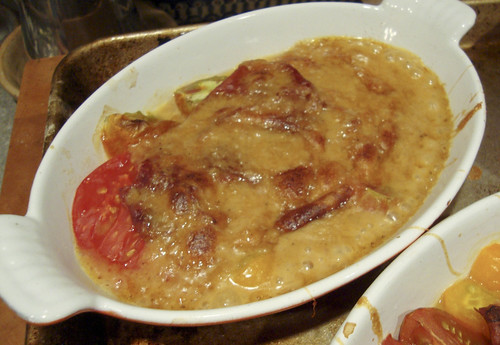
Use Your Booty: Box Car Willie and Friends Rarebit

For the recipe for this delicious bowl of comfort, you're going to have to head over to Food52. This rarebit was an Editor's Pick in the recent heirloom tomato contest. Those of you familiar with rarebit will wonder where the toast is. Just think of the tomatoes as the toast and go happily on your way. I recommend you have some bread on hand to sop up the gorgeous tomatoey-cheesiness that will be in the bottom of the dish.

I used a combination of tomatoes: a big beefy type, a few cherries and a stripy saladette number - no idea of the names of any of them. A note of warning: the tomatoes will be insanely hot when you pull the dish out of the oven. As painful as it will be to wait for them to cool, it will be less painful than the scorched mouth you'll have otherwise.


This Summer, I am chronicling my first CSA (Community Supported Agriculture) experience. My CSA share is from Arrowhead Farm, a farm based in Newburyport, MA. Each week, I am posting about what was in my share and what I'm doing with it. By way of full disclosure, I won my share through a raffle and am not paying for it. However, Arrowhead did not know I was entered in the raffle, and I received no special consideration because of this blog. I paid for my livestock share. A full set of all the photos I've taken of this share is here.

Thursday, August 12, 2010

Cooking Class: Yes We Can Can!

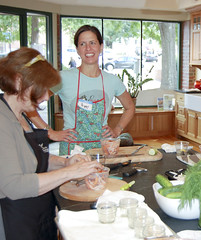
Last week I ran a canning workshop at the gorgeous Jewett Farms Studio in Newburyport, MA. We had a great group of students join us for this class. We made: Blueberry-Lemon Jam, Plum Chutney, Quick Pickles and Personalized Dills.

First off, everyone was put to work chopping up plums for the chutney. I demonstrated a basic technique for cutting up onions and a quick way to cut clingstone stone fruit from its pit. After the chutney simmered down to a thick consistency (about 90 minutes), it was ladled into pint jars and processed in a boiling water bath.

Next, we started the blueberry jam. This jam has whole lemon slices in it and they provide a nice bitter/sour note to the jam. I used my enormous skillet (18"!) and was able to fit four pounds of berries into its wide embrace. The berries and lemons bubbled away and when the hot mixture reached set (220 degrees Fahrenheit) we pulled the jam from the heat and ladled it into 4 oz. jars. Jams don't have to be hot water processed, but for safety's sake and to ensure a seal, we processed our jam for 10 minutes.

While everything simmered away, the class turned its attention to our last two pickles. I demonstrated a quick julienne technique (a way to cut thin strips of vegetables) and put everyone to work julienning a mountain of carrots and two ginormous daikon radishes. These vegetables were salted and left to sit to exude some liquid.

Finally everyone dressed their pickles to their taste (with Japanese chilies and Korean thin pepper strings) they were dressed with a rice wine vinegar/sugar brine and left to pickle at room temp. These pickles need to be eaten within a week or so.

Finally the dills: The class cut up enough cucumbers to fill their jars - some went for spears, others for chips. Everyone seasoned their pickle jar to taste with garlic, dill, mustard seed and chilies. After topping with brine, the cukes went in for processing.

At the end of the day, everyone went home with 2 4oz. containers of jam, a pint of chutney, a pint of dills and a pint of quick Asian-style pickles. I'd say that's a pretty good haul for three hours of class time!

I was honored to have two of my fellow Food52istas join me in class. Thanks Midge and Sagegreen for visiting!

See the full set of photos from class starting here.

Saturday, August 7, 2010

CSA Booty - Week 12


Be sure to check out Use Your Booty: Show Your CSA Box Who's Boss for ideas about how to manage your CSA vegetables.

In this week's share I picked up:
  • 9 ears of corn
  • 3 zucchini
  • 1 head of cabbage
  • 1 cucumber
  • A lotta tomatoes
  • A whole mess of Anaheim chile peppers (I used three of my choices to make sure I got enough for us for dinner)
  • 5 jalapenos
  • I had more options in "pick your own" but didn't have time, so I had to pass on some flowers and greens. Boo.
So here's what I think I'm doing with these items:
  • We've already eaten half the corn - steamed with butter. Yum.
  • I stuffed the Anaheims with Monterey jack and some thinly sliced onions. We ate them last night with the corn.
  • The cabbage could become sauerkraut but is more likely to become a slaw.
  • I think I'll make fritters with the zucchini and pickle some of the rest.
  • I'm have to make this tomato rarebit to test for Food52 and plan on using the great heirlooms I picked up.
  • I'll turn the plum tomatoes I got into a simple pasta sauce.
So how'd I do with last week's haul? Here's what we ate from the CSA last week:
  • I made a green lasagna with the amaranth, kale and onions
  • We made a super delicious stack of BLTs - my bacon comes from North Country Smokehouse, it's amazingly smoky and really makes the dish.
  • We enjoyed a lovely plate of green pasta with tomato sauce and burrata.
  • I am confident that I have a stash of leftover vegetables waiting in the fridge that I'll need to address later today.
This Summer, I am chronicling my first CSA (Community Supported Agriculture) experience. My CSA share is from Arrowhead Farm, a farm based in Newburyport, MA. Each week, I am posting about what was in my share and what I'm doing with it. By way of full disclosure, I won my share through a raffle and am not paying for it. However, Arrowhead did not know I was entered in the raffle, and I received no special consideration because of this blog. I paid for my livestock share.

Friday, August 6, 2010

Use Your Booty: Pasta Verde with Tomato Sauce and Burrata


After making that green lasagna on Tuesday I still had some leftover pasta dough. So I wrapped it up and left in the fridge to await future use (or the compost bin). Tonight I made a quick tomato sauce with the remainder of our CSA tomatoes (mostly cherry tomatoes) and decided to roll the rest of the pasta and have it for supper.

As an aside: I got this Kitchen Pasta Rolling dingus for Christmas (thanks Mom!). If you like fresh pasta I can't recommend the purchase (or gifting, if you are so lucky) of of these more highly. A hand cranked machine isn't that hard to use, but this motorized roller makes pasta making so much faster.

I rolled the pasta and turned it into corzetti (or croxetti), a hand-stamped round pasta from Genoa, Italy. That there is my corzetti stamp, purchased on our trip to Genoa a few years ago. And down there, is a tray of corzetti ready for boiling. For those playing along at home, I rolled my to "6" on the pasta roller - this is a thicker setting (the thinning setting is "8") about what I would use for linguine.

Burrata is a cheese made of mozzarella wrapped around fresh cheese curd. If you can't find it, a few slices of fresh mozzarella and/or a scoop of fresh ricotta would be a satisfactory substitute.

So, no recipe today, just the idea for you:

Make a fresh tomato sauce: I used about 1 pound of tomatoes (coarsely chopped) and 2 cloves of garlic, sautéed together until the tomatoes broke down and got saucy. I didn't seed or skin my tomatoes, but probably should have (the cherry tomatoes seeds and skins were a little tough). Season to taste with salt & pepper.

Boil up some fresh pasta (about 3-4 ounces per person).

Sauce the pasta with the sauce and top the dish with a few slices of burrata.


This Summer, I am chronicling my first CSA (Community Supported Agriculture) experience. My CSA share is from Arrowhead Farm, a farm based in Newburyport, MA. Each week, I am posting about what was in my share and what I'm doing with it. By way of full disclosure, I won my share through a raffle and am not paying for it. However, Arrowhead did not know I was entered in the raffle, and I received no special consideration because of this blog. I paid for my livestock share. A full set of all the photos I've taken of this share is here.
Blog Widget by LinkWithin